Reliable water supply is a business requirement for agricultural irrigation, livestock operations, municipal water projects, and remote applications. Solar pumping can reduce dependence on conventional energy, but photovoltaic output naturally changes with sunlight. For project operators, the challenge is not simply running a pump during sunny hours; it is maintaining dependable water delivery when solar conditions fluctuate. We at FRECON see AC/DC power flexibility, intelligent switching, and effective energy management as key factors in building a more reliable solar pumping system.
Why Solar Pumps Need More Than Daytime Solar Power
A photovoltaic array produces DC electricity, while many commercial water pumps use AC motors. An inverter therefore plays an important role by converting and controlling electrical power so the pump can operate from the available energy source. FAO notes that PV pumping systems can use an inverter to synthesize AC power for conventional AC motors, while MPPT helps match available solar power with pump requirements.
The limitation is that solar generation varies with weather and time of day. Strong sunlight can provide substantial power, while clouds, early mornings, and evenings reduce PV output. A system designed only around solar availability may therefore experience interruptions or insufficient pumping when water demand remains constant.
This is where an AC DC power inverter with appropriate source-management capabilities becomes valuable. Rather than treating solar power as the only available source, a hybrid arrangement can combine solar DC input with grid AC input. The system can then use solar energy when conditions are suitable and rely on the grid when solar generation cannot adequately support the pump.
How Automatic AC/DC Switching Supports Continuous Operation
For commercial users, automatic source switching is more practical than requiring operators to manually change the power supply. A solar pump inverter equipped for both solar DC and grid AC input can manage changing energy conditions while keeping the pumping process more consistent.
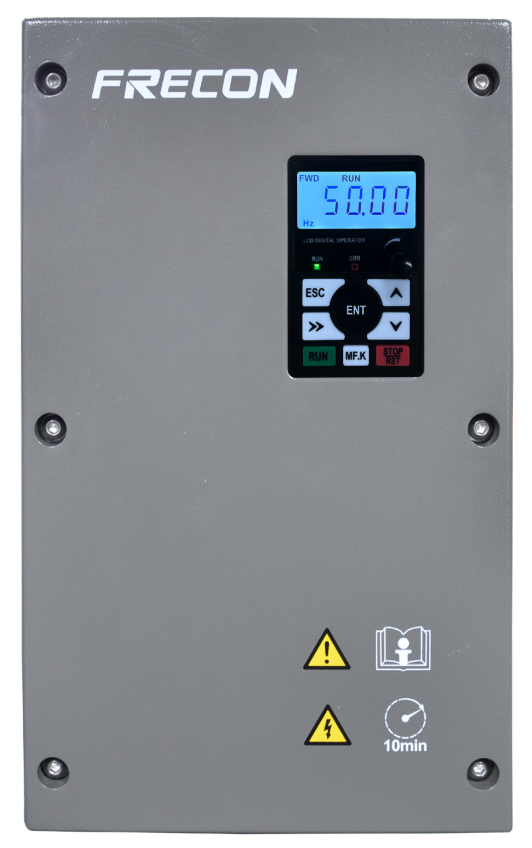
FRECON’s PV380 Series Solar Pump Inverter supports solar power DC and power-grid AC input, with automatic DC/AC switching. This configuration helps address one of the fundamental challenges of solar pumping: maintaining pump operation when solar generation is insufficient.
The principle is straightforward. During periods of adequate sunlight, the system can use photovoltaic power to drive the pump. When solar conditions weaken, grid power can become the available source. This reduces the dependence of water delivery on a fixed level of solar irradiation and can be particularly useful for applications where interruptions have operational consequences.
MPPT Helps Capture Available Solar Energy
Source flexibility is only part of reliable operation. Efficient use of available photovoltaic power also matters because system performance changes with irradiance. Maximum Power Point Tracking, or MPPT, continuously helps the system operate around the solar array's available maximum power point.
For us, this is an important feature when evaluating a solar pump inverter for professional applications. The PV380 Series uses advanced MPPT algorithms, with efficiency reaching 99% according to FRECON's published product specifications. The company also specifies larger water yield under the same conditions, making energy utilization a central part of the product's positioning.
Better utilization of available solar power can support more productive pumping during daylight hours. For system designers, this means the inverter should be assessed not only by its nominal electrical characteristics but also by how effectively it manages changing PV conditions and pump loads.
Outdoor Reliability Matters for Pumping Projects
Solar pumping equipment is frequently installed outdoors, where equipment can be exposed to changing temperatures and environmental conditions. An inverter selected for these applications therefore needs an enclosure and operating range appropriate for the installation environment.
The PV380 Series has an IP65 design for outdoor installation and a specified operating temperature range of -10°C to 60°C. These specifications can be important considerations for engineering teams planning installations in agricultural, rural, or other outdoor locations.
The series is also applicable to AM and PMSM motors, giving project planners flexibility when matching the inverter with different pump motor configurations. Proper matching remains essential because the inverter, motor, pump, hydraulic requirements, and available power sources all need to work as one system.
Remote Monitoring Adds Another Layer of Control
Continuous operation is easier to manage when operators can see system conditions without being physically present. For remote pumping sites, this can reduce the need for frequent on-site inspections and provide useful operational visibility.
FRECON specifies optional 4G/Wi-Fi modules for all PV380 models, enabling real-time remote monitoring and operation through APP and WEB platforms. This gives project operators another tool for managing geographically dispersed pumping installations.
FRECON's product documentation also describes functions such as dormancy during weak sunlight and automatic wake-up under stronger sunlight. Protection functions include over-current, over-voltage, phase-loss, short-circuit, and over-temperature protection.
Building a More Reliable 24/7 Pumping Strategy
We believe 24/7 solar pumping should be viewed as a system-design objective rather than a claim that solar panels alone can continuously generate power. A dependable arrangement needs appropriate PV sizing, a correctly matched pump and motor, suitable electrical protection, and a reliable backup source where uninterrupted operation is required.
An AC DC power inverter with automatic source management can help bridge the gap between variable solar generation and consistent pumping demand. Meanwhile, a capable solar pump inverter can improve solar utilization, coordinate motor operation, and provide monitoring functions that help operators manage the installation.
FRECON's Approach to Reliable Solar Pumping
At FRECON, we develop inverter solutions for applications including farm irrigation, drinking-water supply, and desert management. Our PV series converts solar-panel DC power into AC power for driving different water pumps, while the PV380 Series adds solar/grid input flexibility, automatic DC/AC switching, advanced MPPT, outdoor-ready IP65 protection, and optional remote monitoring.
For business project buyers, these capabilities lay a practical foundation for designing solar pumping systems around both energy efficiency and operational continuity. By combining solar power utilization with grid backup and intelligent control, the right solar pump inverter can help businesses maintain water availability even when sunlight is not consistently available.