Paper mills operate continuous production lines where even a brief web break can interrupt production, increase material waste, and require operator intervention. For this reason, motor control deserves attention beyond simple speed regulation. Stable acceleration, deceleration, torque response, and tension management all influence how reliably a paper web travels through different sections of a machine. For mill engineers and OEMs, selecting suitable motor drive solutions is therefore an important part of improving runnability and production efficiency.
Why Motor Control Matters for Paper Web Stability
Paper web tension must remain within an appropriate operating range. Valmet notes that excessive web tension can cause a sheet to break, while insufficient tension can contribute to flutter and wrinkles. During acceleration, abrupt changes in velocity can also create temporary tension losses that affect web control. These observations show why drive performance and mechanical tension control need to be considered together.
A paper machine may contain multiple motor-driven sections, including rolls, unwinders, winders, pumps, fans, and other auxiliary equipment. Their operating conditions are interconnected. If one drive changes speed too abruptly or fails to respond appropriately to changing load conditions, the resulting disturbance can propagate through the web.
For this reason, an electric drive system should be selected according to the actual process rather than based only on motor power. Engineers should evaluate speed accuracy, torque response, acceleration profiles, overload capability, feedback requirements, and communication with the wider automation system.
Key Factors When Selecting Motor Drive Solutions
The first consideration is controlled acceleration and deceleration. A drive that allows engineers to configure suitable ramp characteristics can help avoid sudden speed changes. Valmet specifically identifies abrupt velocity changes during acceleration as a potential source of temporary tension variation and recommends appropriate drive tuning for smoother transitions.
The second consideration is torque performance. Paper-processing equipment can experience changing mechanical loads, particularly during winding and unwinding as roll diameter changes. The drive must maintain stable motor operation while responding to these conditions. High-quality vector control can provide more consistent torque and speed behavior than basic open-loop control in applications requiring greater dynamic performance.
The third consideration is protection and operational reliability. Overcurrent, overvoltage, overload, and overheating can disrupt production if they are not properly managed. A drive with integrated protection functions can help safeguard equipment and provide operators with useful diagnostic information when abnormal conditions occur.
Building a Better Electric Drive System for Continuous Production
A reliable electric drive system should not be viewed as an isolated inverter connected to a motor. It is part of a broader control architecture that can include PLCs, HMIs, sensors, tension measurement devices, motors, and communication networks.
Accurate tension measurement is particularly important. ABB explains that web tension measurement supports maintaining tension within the desired range during acceleration and deceleration, which can contribute to web quality, uptime, and prevention of web breaks.
Drive selection should therefore be coordinated with the tension-control strategy. The correct motor drive cannot compensate for every mechanical or material problem, but appropriate drive dynamics can provide a stable foundation for the control loop. Engineers should also examine roll alignment, mechanical backlash, sensors, and process settings when investigating recurring breaks.
How FRECON Supports Industrial Motor Control
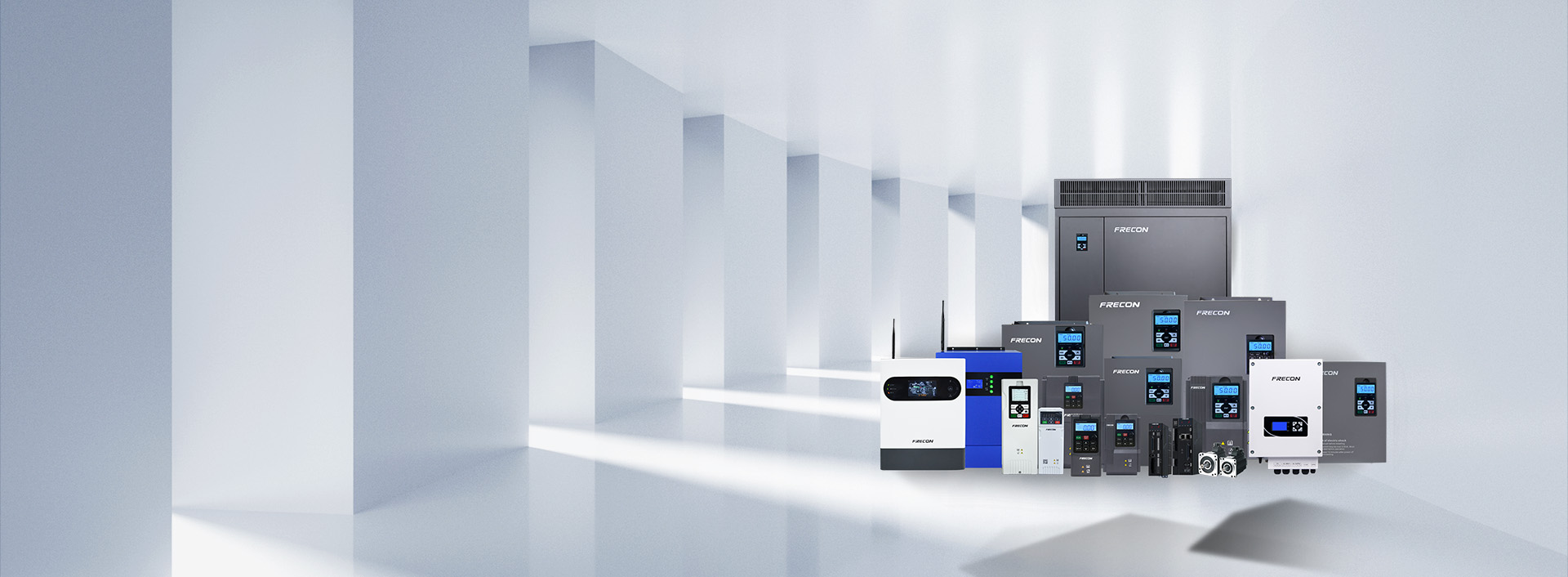
At FRECON, we develop electric drive products for industrial applications, with experience covering inverters, servo drives, energy-saving control cabinets, industrial robots, solar inverter systems, and electric vehicle drive and control systems. Our product portfolio covers power levels from 0.2 kW to 1 MW, giving engineering teams a broad range of options when designing motor control architectures.
For applications requiring vector control, our FR20 Series General Vector Inverter provides several functions relevant to demanding motor-control environments. According to our official product information, the FR20 includes a built-in DC reactor, standard C3 filter, built-in brake unit, built-in STO function, common DC bus support, parameter-copy keyboard support, independent air-duct design, and through-wall installation support.
The FR20 also supports V/F control and two sensorless vector-control modes. Its specified speed-control precision reaches ±0.5% under V/F control and ±0.2% under the two sensorless vector-control modes. Torque response is specified at less than 10 ms for these sensorless vector-control modes.
These specifications do not mean that every paper-machine section should use the same drive. Instead, we recommend evaluating the motor, load characteristics, required speed range, control architecture, and process requirements before selecting the appropriate model. The FR20 can be considered where its capabilities and power rating match the application.
Practical Selection Priorities for Paper Mills
When evaluating motor drive solutions, paper mills should begin with the causes of their existing web breaks. If breaks coincide with acceleration, deceleration, speed changes, or roll-diameter transitions, drive tuning and dynamic response deserve closer examination. If breaks occur randomly, mechanical alignment, material defects, tension measurement, and other process factors may also require investigation.
Engineers should also consider maintainability. Parameter-copy functions, clear monitoring, protective functions, and accessible installation can simplify commissioning and service work across multiple drives. For larger systems, common DC bus architectures may also be worth evaluating where the application benefits from shared DC-bus operation.
Making Drive Selection Part of Break-Reduction Strategy
Reducing paper web breakage requires more than installing a higher-performance inverter. Stable web handling depends on coordinated mechanical, electrical, and process control. Valmet's technical guidance shows that tension variation, acceleration behavior, traction, winding conditions, and mechanical issues can all influence web stability.
We believe the best approach is therefore application-specific. By matching motor characteristics and drive performance with the tension-control strategy and machine requirements, engineers can build a more predictable electric drive system. With abroad industrial drive portfolio and more than a decade of experience in energy-conversion technology, FRECON provides drive options that can be evaluated as part of this wider engineering strategy. Our products comply with EMC and CE requirements, supporting their consideration for industrial equipment projects where applicable.