Passenger expectations for elevators go beyond basic transportation. Smooth starting, controlled acceleration, accurate leveling, and gentle stopping all influence how passengers perceive elevator quality.
For elevator manufacturers and system integrators, these characteristics depend heavily on the drive and control architecture. A dedicated elevator VFD drive can provide functions specifically adapted to elevator motion, helping engineers manage speed transitions and motor behavior more precisely than a general-purpose drive.
Why Elevator Motion Requires Specialized Drive Control
An elevator repeatedly accelerates from standstill, travels at operating speed, decelerates, and stops at a designated floor. Each transition affects passenger comfort. If acceleration changes too abruptly, passengers can feel a noticeable jerk. Poorly controlled deceleration can similarly affect the final approach and leveling process.
A general-purpose inverter may provide variable-speed motor control, but elevator applications have more specialized requirements. The drive needs to coordinate different speed stages and respond predictably to changing load conditions. FRECON's own elevator application experience identifies smooth starting, strong acceleration performance, high starting torque, and overload capacity as important technical requirements for elevator and escalator drive systems.
For business elevator manufacturers, this means drive selection should be based on the complete motion profile rather than simply the motor's rated power.
How S-Curve Acceleration Improves Ride Comfort
One of the most important features of a specialized elevator VFD drive is S-curve acceleration and deceleration. Rather than changing acceleration abruptly, an S-curve profile allows the transition into and out of acceleration to be managed progressively.
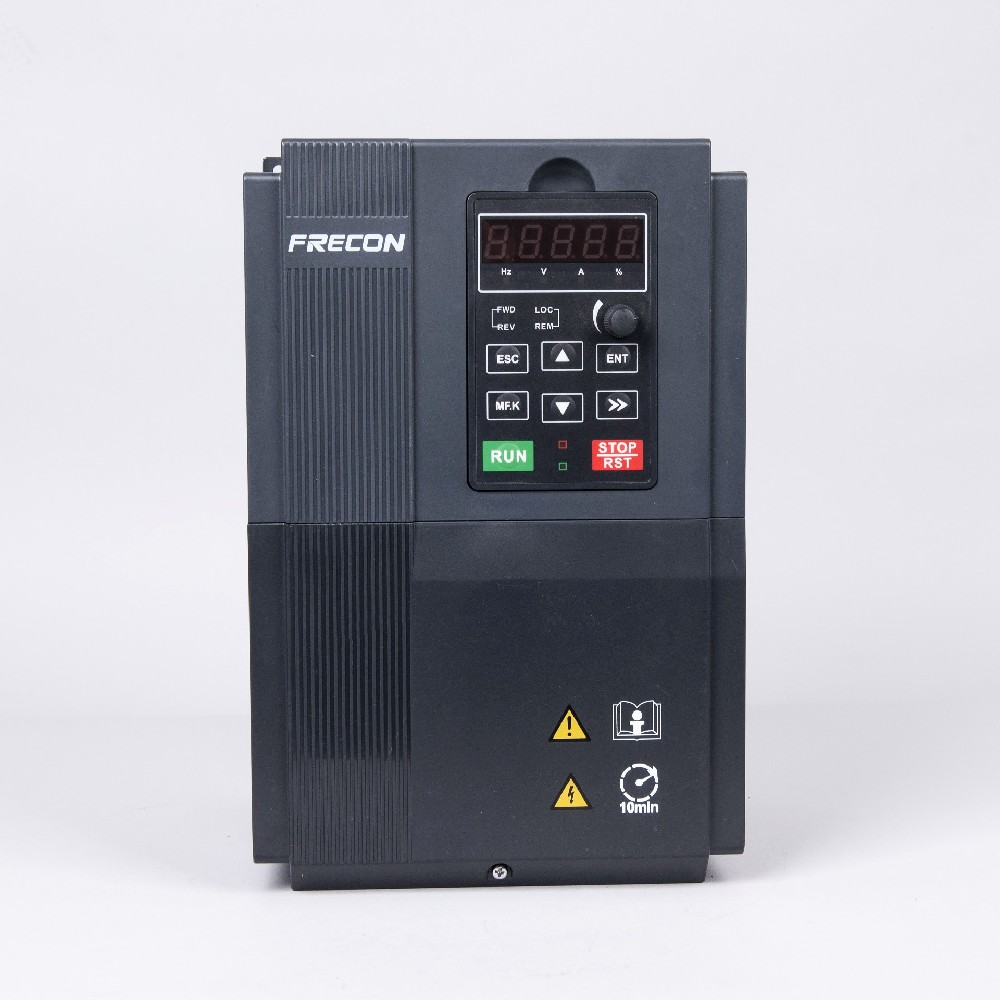
FRECON's FR500D Series Elevator Inverter specifically incorporates multi-stage S-curve control. The official product information states that it supports flexible starting curve processing, multi-stage S-curve settings, and four levels of acceleration and deceleration time settings. The elevator-specific design is intended to improve ride comfort and leveling performance.
This flexibility is valuable because elevator installations differ in load, travel distance, motor characteristics, and control requirements. Engineers can adjust the motion profile instead of applying one fixed acceleration pattern to every installation.
Speed Accuracy Matters at Floor Leveling
Passenger comfort is not determined only by acceleration. The final approach to a floor also requires accurate speed control. Excessive speed near the landing can make leveling more difficult, while poorly coordinated speed transitions may cause passengers to feel movement immediately before the car stops.
The FR500D supports V/f control, sensorless vector control, and closed-loop vector control. Its documented specifications provide speed accuracy of ±0.5% under V/f control, ±0.2% under sensorless vector control, and ±0.1% under closed-loop vector control. Torque response is specified at less than 10 ms for sensorless vector control and less than 5 ms for closed-loop vector control.
These capabilities give elevator system designers different control options according to the motor, feedback configuration, and performance requirements.
Starting Torque Supports Stable Elevator Operation
Elevators must generate sufficient torque from low speed, particularly when starting with an uneven passenger or goods load. Insufficient starting torque can affect acceleration performance and cause undesirable movement during the initial stage of travel.
FRECON's FR500D documentation specifies starting torque of 180% at 0.5 Hz for V/f control and sensorless vector control 1, 180% at 0.25 Hz for sensorless vector control 2, and 180% at 0.0 Hz for closed-loop vector control.
Such low-speed torque capability is particularly relevant to elevator applications because the motor must transition reliably from a stationary condition into controlled movement. FRECON has also documented FR500D applications in elevators and escalators where low-frequency starting, high torque, and fast response support smooth operation.
FRECON FR500D: Designed for Elevator Applications
At FRECON, we developed the FR500D Series specifically for elevator applications rather than simply adapting a general-purpose drive. The series supports open-loop and closed-loop vector control and incorporates elevator-oriented functions that address common motion-control requirements.
The FR500D also provides a power-failure self-help function. According to our official product information, DC 48 V battery input or single-phase 220 V input can be selected for this function. This can help elevator designers develop an emergency self-help strategy for power-loss situations, subject to the overall system design.
Another practical feature is the built-in brake unit available for models rated at 75 kW or lower. Integrating this function can reduce the number of external electrical components required in applicable system configurations.
Supporting Reliable Elevator Drive Integration
Ride comfort depends on more than the inverter alone. Motor selection, encoder feedback, mechanical transmission, braking components, counterweight configuration, elevator controller, and commissioning parameters all influence final performance.
For this reason, we consider motor parameter identification an important part of drive commissioning. The FR500D provides motor parameter auto-tuning, including static tuning and full tuning functions. These features can help engineers configure the drive according to the connected motor rather than relying entirely on manually entered parameters.
The series also uses an independent duct design across its range and incorporates professional lightning-protection design, according to FRECON's product documentation. These hardware considerations can support reliable operation when the drive is installed in appropriately designed elevator control systems.
Selecting an Elevator Inverter for Long-Term Performance
For elevator OEMs and engineering contractors, choosing an elevator inverter should involve more than comparing nominal power ratings. The required speed-control method, starting torque, acceleration profile, leveling accuracy, braking arrangement, emergency functions, and motor compatibility should all be evaluated.
We believe a specialized drive offers an important advantage because its functions are developed around the actual motion requirements of elevators. Rather than adding general-purpose functions through extensive external programming, engineers can work with control features designed for elevator operation.
At FRECON, our experience in inverter and drive development spans more than a decade, with products covering applications in industrial automation, energy efficiency, and green new energy. Our product power range covers 0.2 kW to 1 MW, while our products comply with applicable EMC and CE requirements.
Building a Better Passenger Experience Through Drive Selection
A comfortable elevator ride begins with controlled motion. Multi-stage S-curves can smooth acceleration and deceleration, accurate vector control can support precise movement, and strong low-speed torque can help stabilize starting. Additional functions such as motor auto-tuning and power-failure self-help can further support the overall elevator control strategy.
We designed the FR500D Series around these practical requirements. By choosing an elevator VFD drive developed specifically for elevator applications, OEMs and system integrators can gain control functions that align more closely with the demands of passenger transportation. For us, the goal is not simply to regulate motor speed, but to help engineering teams create elevators that operate smoothly, predictably, and reliably.