Warehouse automation is placing greater demands on automated guided vehicles (AGVs). These mobile machines must move materials reliably while operating within increasingly space-constrained and highly automated facilities. For AGV manufacturers and system integrators, motor control is therefore an important design consideration.
A properly selected inverter can support controlled motor operation while fitting into compact electrical enclosures. We at FRECON see the combination of compact design, flexible control, and practical integration as especially valuable for modern warehouse equipment.
Why AGV Motor Control Requires a Compact Approach
AGVs operate within environments where available installation space can be limited. Their electrical systems must accommodate motor drives alongside batteries, controllers, communication equipment, sensors, and other components. This makes enclosure utilization an important consideration for OEMs developing compact mobile platforms.
Warehouse automation is also moving toward more flexible and adaptive material-flow systems. Siemens, for example, identifies energy efficiency, sustainability, flexibility, and automation as important requirements for modern intralogistics. For AGV designers, these requirements increase the importance of selecting drive components that can integrate efficiently into the overall vehicle architecture.
A slim inverter can provide a practical advantage here. By reducing the space occupied by the drive, designers may have greater freedom when arranging other electrical components. However, physical size should never be considered alone. Motor-control functions, installation requirements, operating environment, and system compatibility must also be evaluated.
What to Look for in a Slim Inverter
When we evaluate inverter solutions for compact automated equipment, we focus first on installation efficiency. A narrow housing can help reduce cabinet width and improve component arrangement, particularly when multiple drives or other control devices need to share limited space.
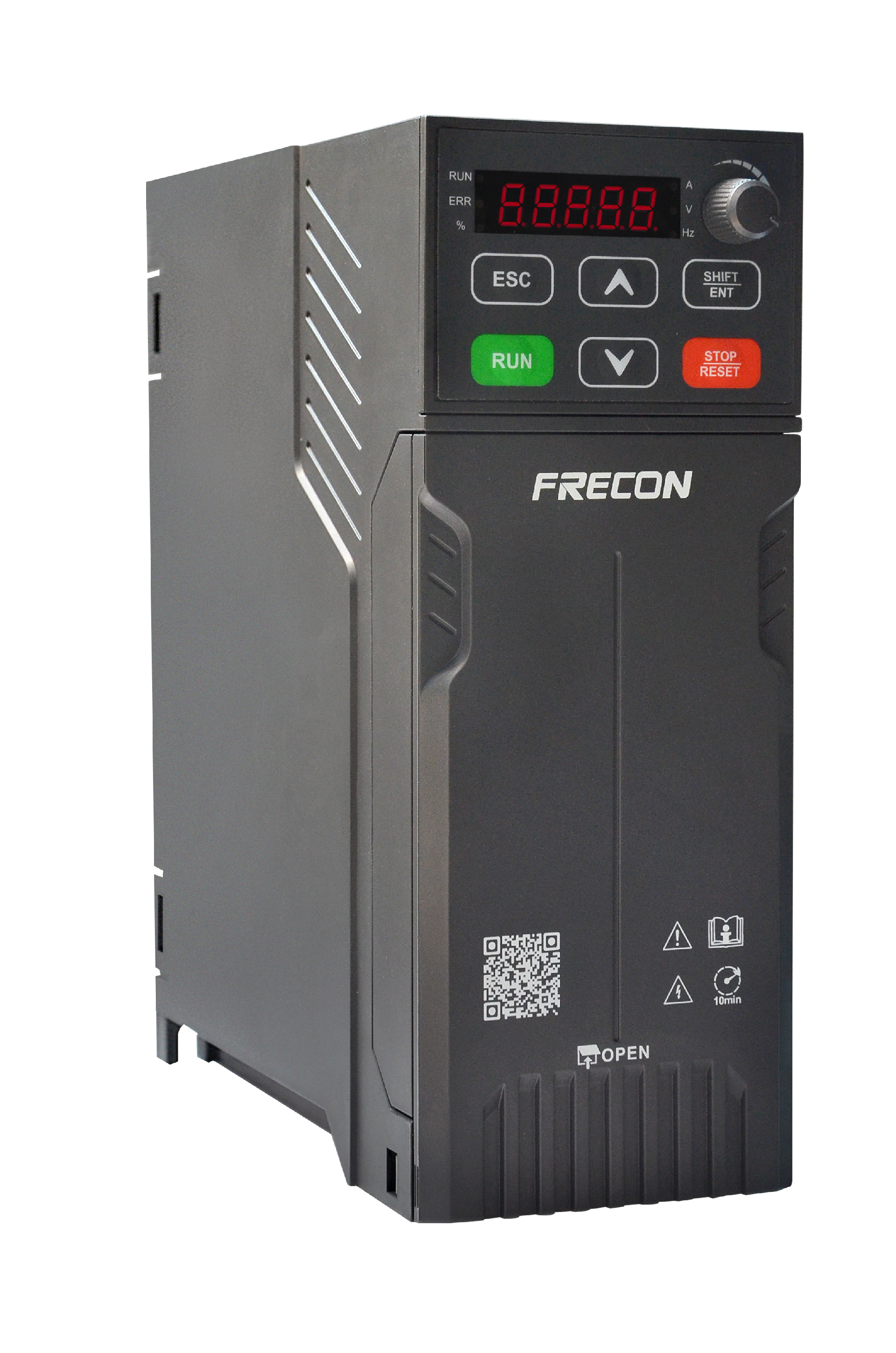
The FR01 Series Smart Inverter from FRECON adopts a book-type narrow-body design specifically intended to support compact installations. FRECON states that the series is suitable for control-cabinet installation and can help save wiring and front-panel space.
The series also supports side-by-side installation with zero spacing, according to FRECON's product information. This feature can help system integrators make better use of available cabinet width when designing compact equipment.
FR01 Series Smart Inverter for Flexible Motor Control
We developed the FR01 Series as a smart inverter combining compact construction with practical motor-control functions. The series incorporates both SVC and V/F control, providing different control approaches for applications with varying performance requirements.
For AGV-related equipment, this flexibility helps ensure that the drive is properly matched to the selected motor and mechanical system. Rather than treating every application identically, engineers can select an appropriate control method based on the equipment's actual requirements.
The FR01 is not positioned by FRECON as an AGV-exclusive inverter. Its listed application areas include fans, water pumps, food processing, woodworking, and transmission applications. For AGV manufacturers, its relevance is therefore primarily its compact form factor and motor-control capabilities, which can potentially support suitable auxiliary or drive architectures.
Smart Inverter Design Helps Simplify Integration
Space efficiency is only useful when installation remains practical. Our FR01 Series supports both wall-mounted and rail-mounted installation, giving engineers more flexibility when determining how the inverter should be positioned within an electrical system. The current FR01 manual specifies an ambient operating temperature range of -10°C to 50°C and requires appropriate ventilation and heat-dissipation arrangements.
The physical dimensions also demonstrate the compact nature of the series. For example, FR01 models in Size A have external dimensions of 65 mm in width, 170 mm in height, and 140 mm in depth. Other models use larger Size B and Size C housings depending on the selected configuration.
For OEMs, this means inverter selection can be considered together with the complete cabinet layout instead of being treated as an isolated purchasing decision.
Balancing Space, Control, and Warehouse Performance
A smart inverter should contribute to the broader equipment design rather than simply provide variable motor speed. AGVs operate as part of connected warehouse systems, where vehicle movement, sensing, automation, and control functions must work together. Siemens notes that AGV development requires close integration between automation, energy management, sensors, drives, and operational requirements.
This is why we recommend evaluating the inverter according to the complete application. Engineers should consider motor type, required speed range, acceleration characteristics, installation space, cooling conditions, control method, and communication architecture before selecting a drive.
Energy performance should also be evaluated at the system level. Variable-frequency drive technology can provide opportunities for energy optimization, but actual savings depend on the motor, load profile, control strategy, and operating conditions. Therefore, we avoid treating inverter efficiency as an isolated figure when assessing an AGV design.
Why FRECON FR01 Fits Compact Automation Projects
Our FR01 Series combines a narrow book-type structure with SVC and V/F control, making it a practical option for engineers prioritizing compact motor-control hardware. Its zero-distance side-by-side installation capability can further support efficient cabinet layouts. FRECON also describes the series as easy to use and designed for plug-and-play setup.
For AGV OEMs and warehouse automation integrators, these characteristics can simplify the physical integration process. Instead of allocating excessive enclosure space to the inverter, engineers can use the compact architecture to create a more organized electrical layout while retaining flexible motor-control functionality.
At FRECON, we understand that industrial automation projects require more than individual component performance. Drive selection must support the mechanical design, electrical architecture, installation environment, and operational objectives of the complete machine.
Building Smarter AGV Drive Architectures
Modern warehouses require AGVs that can operate efficiently within increasingly automated material-flow environments. This makes compact and adaptable motor-control solutions increasingly relevant to equipment designers. A slim inverter can help address physical space limitations, while appropriate control functions can support stable motor operation.
Our FR01 Series Smart Inverter offers a book-type narrow-body design, zero-distance side-by-side installation, SVC and V/F control, and flexible mounting options. These characteristics make it worth considering for suitable compact automation and AGV-related motor-control architectures.
We believe the best drive selection begins with the application rather than the product name. Manufacturers can optimize space utilization and maintain reliable motor control by selecting an inverter that suits the motor, enclosure, thermal environment, and overall automation system. For compact warehouse equipment, that balance is an important step toward smarter engineering.