Large business solar projects require more than a competitive unit price. When we evaluate a solar inverter factory, we need to understand whether its products, engineering capabilities, quality controls, documentation, and support can meet the demands of repeated procurement and long-term field operation. This is particularly important for solar pumping projects, where inverter performance directly affects water delivery. A systematic review helps identify suppliers that offer reliable technical performance, not just impressive specifications.
Start With Product and Application Capability
Our first step is to determine whether a factory understands the actual application rather than offering a generic inverter. Solar pumping systems have specific requirements because photovoltaic generation changes with irradiance while pump loads can vary according to water demand and hydraulic conditions.
IEC 62253 provides requirements for the design qualification and performance measurement of photovoltaic pumping systems, including systems where motor-pump sets are connected to a PV generator through a DC-to-DC or DC-to-AC converter. This makes system-level performance an important consideration when evaluating suppliers.
We therefore examine whether a solar inverter factory has dedicated products for pumping applications, documented operating parameters, and experience covering different water-management scenarios. A supplier focused specifically on solar pumping can offer more relevant engineering knowledge than one treating the application as a simple variation of a general-purpose drive.
Examine Solar Inverter Factory Quality and Standards
Quality claims should be supported by documentation. For large procurement projects, we should request product datasheets, manuals, test information, certifications, and applicable standards instead of relying only on marketing descriptions.
For photovoltaic power conversion equipment, IEC 62093:2022 addresses design qualification and type approval considerations for equipment intended for long-term operation in terrestrial PV systems. IEC 62109-2, meanwhile, covers particular safety requirements for inverters used in photovoltaic power systems.
These standards do not automatically make one supplier better than another, but they provide useful reference points for procurement teams. We can compare a factory's documentation against our project's electrical, environmental, safety, and compliance requirements before placing a large order.
Check MPPT Performance and Power-Input Flexibility
For asolar pumping inverter, energy management is central to system performance. Maximum Power Point Tracking, or MPPT, enables the inverter to track the PV array's available operating point. IEC 62891 provides procedures for measuring MPPT efficiency, including static and dynamic MPPT efficiency for applicable PV inverters.
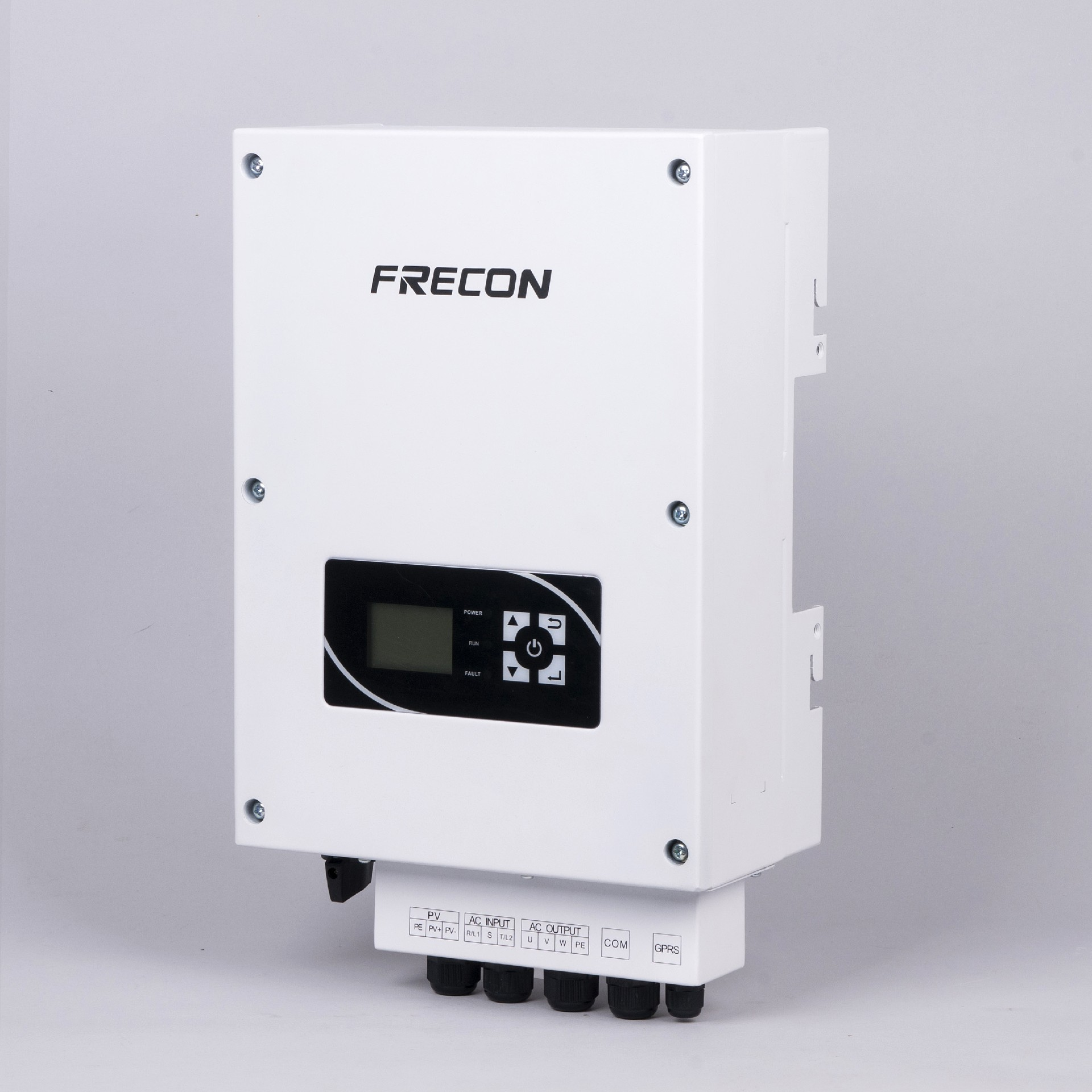
FRECON's PV580 Series uses an optimized MPPT algorithm, with a published MPPT efficiency of more than 99%. The series also supports both DC and AC power input, allowing it to work with photovoltaic power as well as an AC source.
For business buyers, this flexibility can be particularly relevant where grid availability varies by site. We should evaluate the complete input and output specifications against the intended PV array, motor, pump, and backup-power configuration rather than comparing an isolated efficiency figure.
Evaluate Environmental Protection for Real Installations
A solar inverter may be installed directly outdoors, often near agricultural fields, water sources, or remote infrastructure. Environmental specifications therefore deserve the same attention as electrical specifications.
The FRECON PV580 Series uses an IP65 enclosure and is specified for an operating temperature range of -25°C to 60°C. FRECON also specifies natural cooling for the series, which avoids relying on forced-air fans for its cooling method.
For procurement teams, these specifications should be assessed against the actual installation environment. We should consider ambient temperature, solar exposure, dust, moisture, altitude, and enclosure requirements. The objective is not to select the highest specification on paper, but to establish whether the product is appropriately designed for the conditions it will face.
Assess Reliability Features and Maintenance Requirements
Large projects can involve dozens or hundreds of pumping units, so maintenance efficiency becomes a significant commercial consideration. A factory should be able to explain its protection functions, operating procedures, troubleshooting methods, and replacement process.
The PV580 Series includes protection functions covering over-current, over-voltage, output phase loss, short circuit, and over-temperature conditions. Its specifications also list LCD display, RS485/GPRS communication, operation up to 3,000 meters with derating above that altitude, and noise below 50 dB.
These details give us a starting point for assessing maintainability. We should also ask whether manuals are clear, spare parts can be supplied consistently, and technical teams can support commissioning and troubleshooting across multiple project sites.
Verify Scalability Before Placing Bulk Orders
A factory capable of producing one successful prototype is not necessarily prepared for large business procurement. We should investigate production capacity, product consistency, lead times, quality inspection procedures, and the supplier's ability to maintain specifications across repeated batches.
FRECON currently lists the PV580 Series as an IP65 solar pump inverter with a power range of 0.4–110 kW. Its official download center also provides a PV580 Series catalog and a 2026 user manual, giving buyers access to current product documentation during technical evaluation.
This documentation matters because procurement teams need stable references for product selection, installation, commissioning, and after-sales support throughout a project lifecycle.
Choosing a Solar Inverter Partner With Confidence
Selecting a solar inverter factory for large business procurement should involve much more than comparing quotations. We need to examine application expertise, MPPT performance, input flexibility, environmental protection, safety documentation, maintenance features, production scalability, and technical support as one complete evaluation.
At FRECON, we develop dedicated solar pumping solutions for applications including agricultural irrigation, daily water use, and water management in areas with limited electricity infrastructure. Our PV580 Series combines optimized MPPT, DC/AC power-input compatibility, IP65 protection, a -25°C to 60°C operating range, and natural cooling.
For business buyers, these characteristics provide concrete technical points to evaluate alongside factory capabilities. By applying a structured procurement process, we can select a solar pumping inverter supplier based on documented performance, application suitability, and long-term project value rather than price alone.