Solar-powered pumping serves many everyday needs, from irrigating crops and watering livestock to filling household water tanks. Whether you are planning a new system or adding solar to an existing pump, choosing a suitable solar pump inverter helps the equipment work together.
So, how do you choose one that fits your water pump, solar panels and daily water needs?
This guide explains which motor specifications to check, how to match the inverter’s output and what to consider on the solar panel side. These checks help you compare options and choose an inverter that suits your pump and daily pumping needs.
Which Water Pump Specifications Should You Check First?
Before comparing inverters, identify the electrical supply your pump’s motor needs to run. Its nameplate and motor type give you the details to compare with a solar pump inverter, while flow and head describe the pumping job.
1. Read the Motor Nameplate
Detail | Why it matters |
Rated power, in kW or hp | Identifies the motor’s power class |
Rated voltage | Helps select the correct output voltage class |
Rated current, in amps | Shows the current capacity the inverter needs to support |
Frequency, in Hz | Identifies the motor’s rated operating frequency |
Phase, usually 1PH or 3PH | Distinguishes single-phase and three-phase motors |
Record the pump model too. If the motor plate is difficult to read, its datasheet can provide these details.
2. Identify the Motor Type
Your solar water pump inverter needs to support the motor type fitted to the pump. For an AC induction (asynchronous) motor, look for an induction-motor control mode. For a synchronous motor, look for the matching synchronous-motor mode. Some inverters offer both, with the appropriate mode selected for the connected pump.
For a single-phase pump, also ask the supplier to check whether its starting capacitor and wiring are supported.
3. Keep Flow and Head in the Picture
Flow rate describes how much water the pump delivers. Total dynamic head accounts for the lift, required pressure and pipe losses it works against. These figures help select a solar water pump for the job, while its motor ratings provide the electrical information for inverter matching.
How Should a Solar Pump Inverter Match the Pump Motor?
With the motor details recorded, you can check whether a solar pump inverter can supply the electricity it needs. The aim is to match voltage, phase and frequency, then provide enough current for running and starting.
Compare Voltage, Phase, Current and Frequency
Choose an inverter that supports the motor’s rated power, voltage and phase. For example, a 230 V single-phase pump needs support for 230 V single-phase motor output. This is the output specification to compare with the motor nameplate.
The inverter’s continuous output current needs to equal or exceed the motor’s rated current under the installation conditions. Some models provide less usable current in high temperatures or at altitude. Its frequency settings also need to cover the motor’s rated frequency and the pump’s permitted operating range.
For example, if your motor plate shows 2.2 kW and 6 A, look for a water pump inverter that supports that power rating, provides at least 6 A of continuous output current and matches the motor’s voltage and phase.
Account for Starting Demand
A pump motor needs enough turning force, or torque, to start. A solar pump inverter with variable-frequency control builds speed gradually, helping manage current draw during startup.
An adjustable acceleration time lets the motor build speed at a rate the inverter and pump can handle. Combined with sufficient current capacity, this helps the pump start smoothly and reach its working speed.
What Should You Check on the PV Side?
Even a well-matched motor and inverter need a suitable solar array. The PV side determines whether your solar water pump system can start, keep running and deliver the planned daily volume.
Compare the Different Voltage Limits
Three voltage checks serve different purposes:
l Open-circuit voltage (Voc): The string’s calculated cold-weather Voc stays below the inverter’s maximum DC input voltage.
l Operating voltage (Vmp): The string’s working voltage fits the maximum power point tracking (MPPT) range, including the lower voltage expected as panels heat up.
l Starting voltage: The array reaches the voltage needed for the inverter to begin operating.
Series-connected panels add voltage; parallel strings add current. The combined array current also needs to fit the input limits of the solar pump inverter.
Match Solar Production to the Pumping Schedule
Compare expected solar production with daily water demand, local sunlight, seasonal conditions and shading. This helps estimate the useful pumping hours and daily water volume your array can support.
A solar water pump system filling a tank during sunny hours has more scheduling flexibility than one supplying irrigation at a fixed time. Stored water can also serve later demand without keeping the pump running after sunset.
Look at Backup Power When Timing Matters
If pumping needs to continue through weak sunlight, look for a solar water pump inverter that accepts grid or generator power. The backup supply’s voltage, phase and frequency also need to suit the inverter’s AC input. This gives the system another power source when solar production falls short.
Why Consider the FRECON PV580 Series?
With the motor and PV requirements clear, the next step is finding a model that suits where and when you pump. The FRECON PV580 series combines AC motor compatibility, solar tracking and AC backup input for irrigation, daily water supply and water transfer.
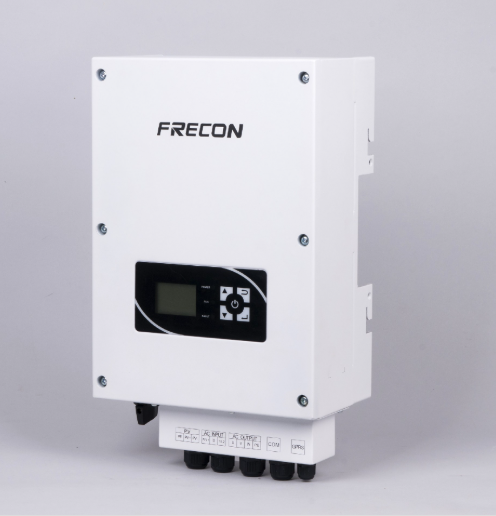
Its solar pump inverter models span 0.4–110 kW, with 220/230 V options and 380–460 V three-phase options across the range. This provides choices for matching different pump sizes and electrical requirements.
l AC motor compatibility: The series supports various AC asynchronous and synchronous pump motors. This creates an opportunity to retain a compatible existing pump when moving to solar, reducing replacement work and cost.
l Optimized MPPT control: The MPPT algorithm tracks available PV power as sunlight changes. This helps the solar water pump inverter make use of changing daytime conditions to support water production.
l DC and AC input: Solar DC input and AC grid or diesel-generator input provide alternative ways to power the pump. Backup capability helps keep watering or tank-filling plans workable during low-sunlight periods.
l IP65-rated enclosure: The enclosure supports outdoor installation, making the solar pump inverter practical for locations near wells, tanks and irrigation areas.
Find the Right Match for Your Water Pump
The right match connects the motor’s electrical needs, the inverter’s output and the array’s available power. With those details in place, the solar water pump system is better prepared for the water demand you want to meet.
If you are still unsure which model fits, share your pump nameplate, planned solar array and daily water needs with FRECON for help finding a suitable PV580 configuration.
FAQs
1. Can You Choose a Solar Pump Inverter by Motor Power Alone?
No. Motor type, voltage, phase, rated current and frequency also affect compatibility. The PV input then needs its own checks.
2. Do Flow Rate and Head Determine Inverter Size?
They help define the pump and motor needed for the job. Once that pump is selected, its motor ratings guide the inverter choice.
3. Why Should You Check Motor Current as Well as Power?
Motor current tells you how much current the inverter needs to supply during normal operation. Comparing it alongside voltage and power helps you choose an output that suits the pump.
4. Do You Need to Check the PV Array After Matching the Inverter to the Pump?
Yes. Compare the array’s voltage and current with the inverter’s PV input limits, then check expected solar production against your pumping schedule.
5. Does the FRECON PV580 Support Grid or Generator Backup?
Yes. Alongside solar DC input, the PV580 supports AC input from the grid or a diesel generator. This gives your pump an alternative power source during cloudy weather or low-light periods, helping keep irrigation and tank filling on schedule.
References
[1] UNICEF and Water Mission. “Solar Powered Water Systems: Design and Installation Guide.” https://globalwatercenter.org/wp-content/uploads/2024/04/Solar_Powered_Water_Systems_Guide_02-2021_English.pdf
[2] World Bank. “Solar Pumping 101: The What, Why, and the How.” https://blogs.worldbank.org/en/water/solar-pumping-101-what-why-and-how