Precision is a core requirement in CNC machining, where spindle behavior directly affects cutting consistency, surface finish, tool performance, and production efficiency. The spindle must respond accurately to changing machining conditions while maintaining stable speed and torque. For manufacturers evaluating drive systems, selecting ahigh performance inverter is therefore more than an electrical specification—it is an important decision for overall machine performance. We believe advanced inverter control can help CNC equipment achieve the responsiveness and stability required by demanding industrial applications.
Why Spindle Control Matters to CNC Precision
The spindle is responsible for rotating the cutting tool or workpiece, so variations in its operating conditions can influence the machining result. During cutting, load changes may occur as the tool enters different sections of a workpiece or encounters different material characteristics. If spindle speed or torque changes excessively, cutting conditions can become inconsistent.
A variable frequency drive controls an AC motor by regulating the electrical power supplied to it. Research on CNC machining-center spindles has demonstrated the application of variable-voltage, variable-frequency control for spindle speed regulation, with control performance evaluated under torque loads and dynamic operating conditions.
For industrial users, the objective is not simply to make the spindle rotate. The drive must provide sufficiently accurate speed control, rapid torque response, and dependable operation across the required working range. These characteristics become increasingly important when CNC equipment is used for precision milling, engraving, drilling, and other processes where cutting conditions must remain consistent.
Speed Accuracy Supports Consistent Cutting
CNC programs can require the spindle to operate at different speeds according to the tool, material, cutting operation, and programmed process. A drive with stronger speed-control capabilities enables the motor to track these programmed profiles with greater precision.
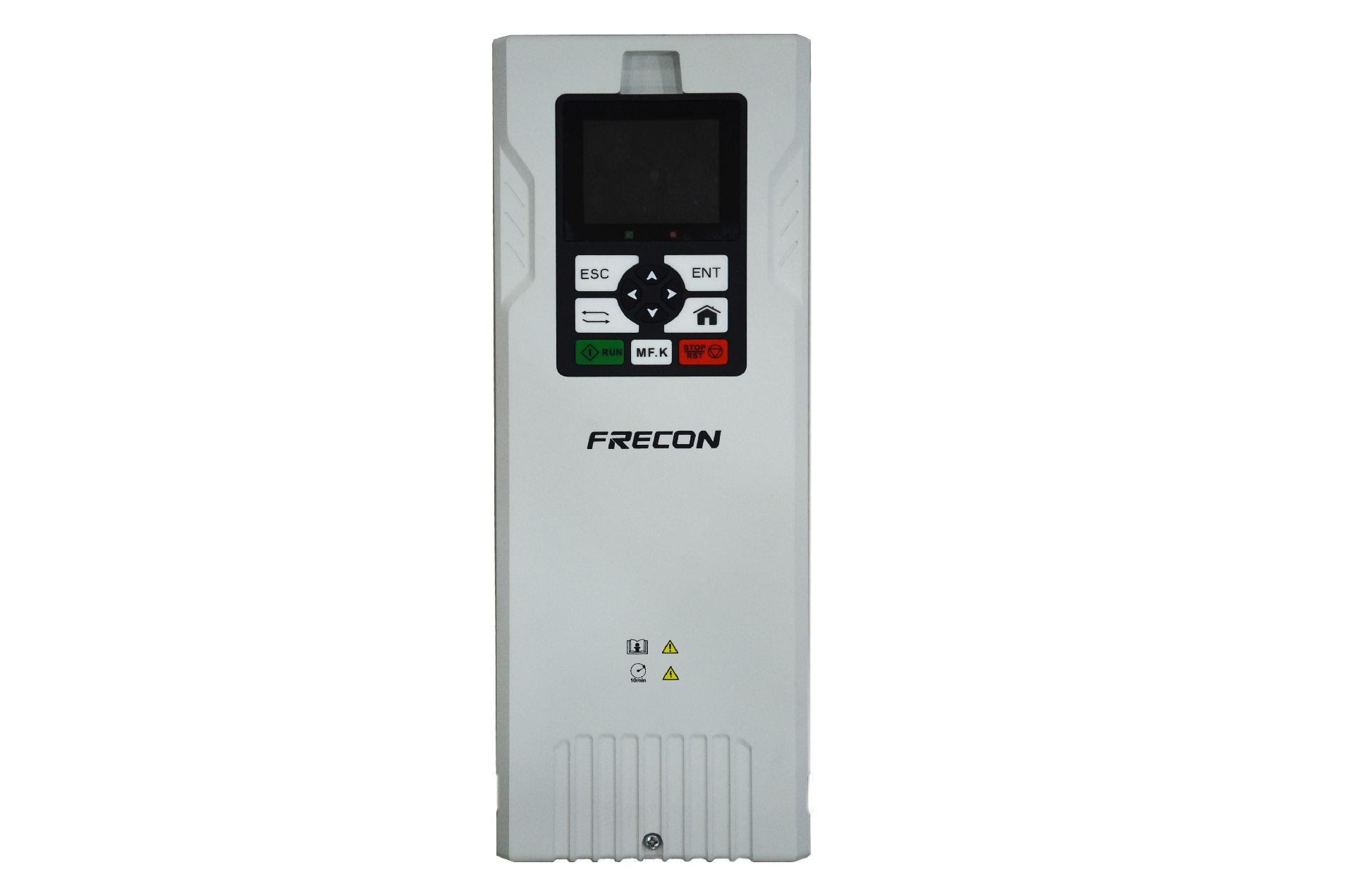
This is one reason we position the FR30 Series as a high performance inverter for applications demanding speed-control accuracy, torque response speed, and low-frequency output characteristics. FRECON’s technical specifications list speed-control precision of ±0.5% under V/F control, ±0.2% under sensorless vector control 1 and 2, and ±0.1% with vector control using PG.
The FR30 also provides a rated output-frequency range of 0.00–600.00 Hz, with a unit resolution of 0.01 Hz. Its speed range varies by control method, reaching up to 1:1,000 with vector control with PG. These capabilities give machine builders and industrial users greater flexibility when matching drive behavior to different motor and machining requirements.
Torque Response Helps Handle Changing Loads
Speed accuracy alone does not define spindle performance. Cutting forces can change rapidly, particularly during demanding machining operations. A drive needs to respond quickly enough to maintain appropriate motor behavior when load conditions fluctuate.
The FR30 Series specifies a torque response of less than 10 ms under sensorless vector control 1 and 2. Its starting torque can reach 180% at 0.5 Hz under V/F control and sensorless vector control 1, 180% at 0.25 Hz under sensorless vector control 2, and 180% at 0.00 Hz with vector control using PG.
For CNC applications, such control characteristics can be valuable when the spindle must maintain stable operation during acceleration, low-speed machining, or changing cutting loads. We see this combination of speed and torque control as an important part of building a more responsive drive system.
Why High Power Density Matters for CNC Equipment
Machine builders must also consider the physical integration of the drive. CNC equipment frequently places multiple electrical and automation components within a limited cabinet space. A high power density inverter can provide greater installed power capability relative to its physical footprint, helping engineers manage cabinet space more efficiently.
The FR30 Series combines high-performance control with a high-power-density design and covers a power range of 0.75–110 kW according to FRECON’s current product information. This range allows system designers to consider the same product family across different machine configurations while selecting an appropriate capacity for the motor and application.
The FR30 also supports wall-mounted or flange mounting and forced-air cooling. Its listed protection options include IP20/IP54, while the technical catalog specifies indoor installation conditions without direct sunlight, dust, corrosive or flammable gases, oil mist, water vapor, water drops, or salt.
Control Flexibility Supports Different CNC Requirements
CNC applications do not all have identical motor-control requirements. A drive that provides multiple control modes gives engineers more options when configuring a machine for specific performance targets.
The FR30 supports V/F control, sensorless vector control 1, sensorless vector control 2, and vector control with PG. FRECON also lists features including high-precision torque control, V/F separated control, torque control, sensorless vector control, and vector control.
Reliability functions are equally important for production environments. The FR30 provides overload capability of 120% rated current for 60 seconds, 145% for 10 seconds, and 160% for 1 second. It also includes protection against conditions such as over-current, over-voltage, under-voltage, over-temperature, and overload.
Building a More Reliable CNC Drive System
Choosing an inverter should always begin with the motor, spindle, machine architecture, and actual machining requirements rather than with power rating alone. Engineers should evaluate speed-control precision, torque response, frequency range, overload capability, control mode, installation conditions, and compatibility with the broader CNC control system.
Our FRECON FR30 Series is designed as a full-featured industrial inverter for applications requiring advanced motor control. With its combination of flexible control methods, high power density, wide frequency range, torque response, and protection functions, it offers a practical option for machine builders and industrial users seeking stable spindle-drive performance.
Precision Starts with the Right Drive Architecture
CNC accuracy depends on the coordinated performance of mechanical, electrical, and control systems. The inverter cannot compensate for every limitation elsewhere in the machine, but it plays an important role in controlling the motor behavior that directly influences spindle operation.
For manufacturers developing or upgrading CNC equipment, a carefully selected high performance inverter can provide the control precision and dynamic response needed for demanding machining tasks. When cabinet space and power requirements are also important, a high power density inverter such as our FR30 Series can provide another valuable design advantage. Evaluating these parameters enables optimal drive selection, building CNC systems with consistent, reliable, and production-ready performance.