Industrial control cabinets must accommodate drives, PLCs, terminals, protection devices, wiring, and cooling arrangements. As machinery becomes more compact, simply specifying a larger enclosure is rarely the best answer. At FRECON, we see wall-mounted VFD configurations and through-wall designs as practical ways to reorganize the installation footprint. For engineering teams, the goal is to reduce cabinet congestion while preserving thermal performance, accessibility, and motor control.
Why Cabinet Space Becomes a Design Constraint
An industrial VFD is often installed inside a cabinet because the enclosure provides organized protection and a controlled environment. However, every drive occupies physical volume and needs clearance for airflow, wiring, and maintenance. Multiple drives can quickly increase cabinet size and layout complexity.
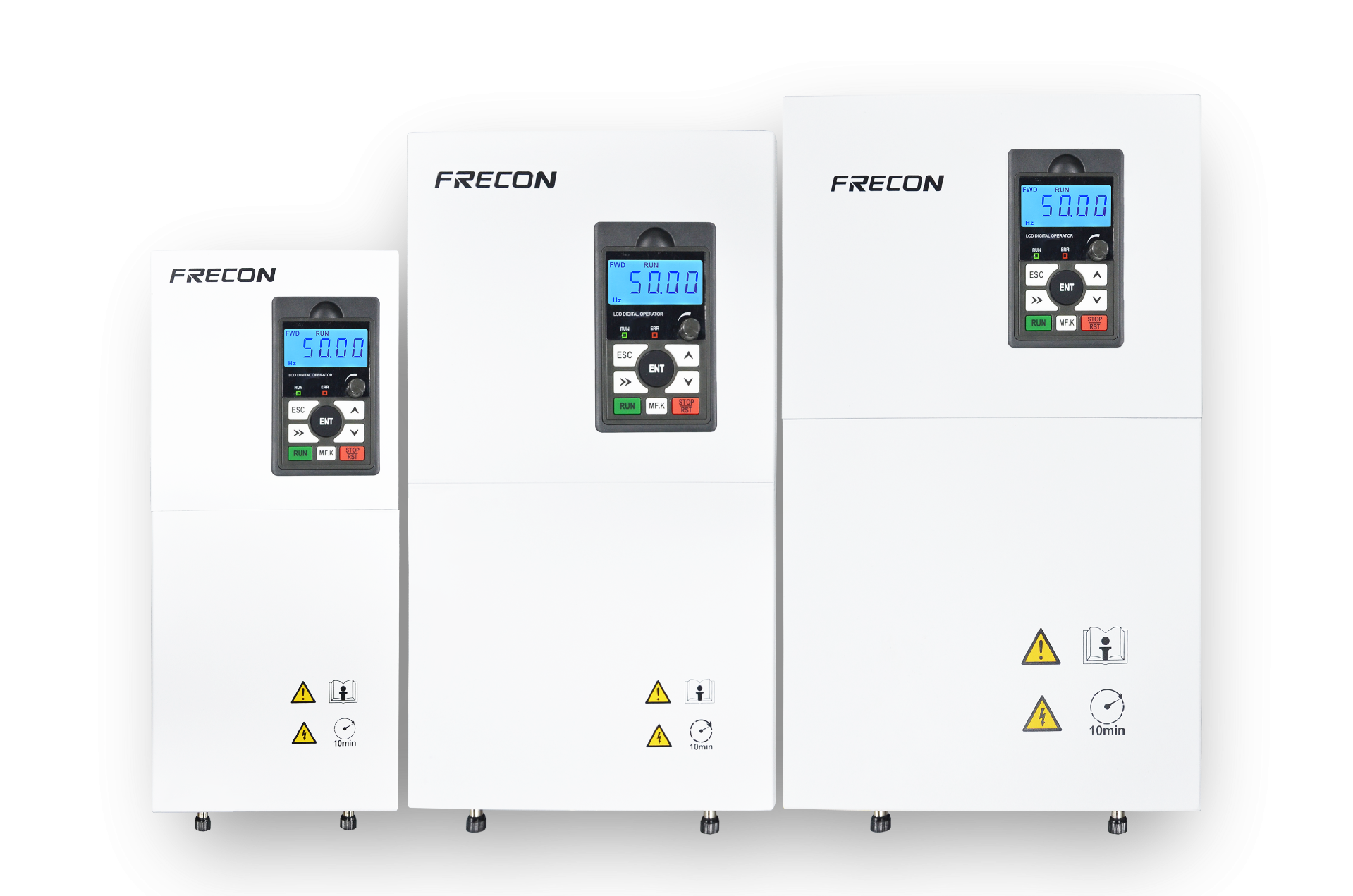
A wall mounted VFD changes that planning approach. Instead of treating the cabinet as the only mounting location, engineers can use suitable wall or panel areas for drive placement. FRECON’s inverter FAQ confirms that its inverters can be installed on a wall or in a cabinet, with vertical installation recommended for heat dissipation. This gives designers another option when cabinet real estate is limited.
Use Through-Wall Installation to Manage Heat
Saving space should never mean simply squeezing components closer together. Thermal management remains important because VFDs generate heat. A useful configuration is to position heat-generating components so heat can be managed outside the control compartment when the design supports this method.
The FR20 Series General Vector Inverter supports through-wall installation. FRECON explains that this configuration can place the heat sink outside the control panel while keeping the electronic portion inside. Where cabinet temperature or internal volume is a concern, this arrangement can help engineers rethink the enclosure rather than simply making it larger.
Plan Airflow Before Mounting the Drive
A compact cabinet still needs adequate airflow. Poorly planned installation can create hot spots and make maintenance more difficult. Engineers should consider heat paths, mounting orientation, clearances, and adjacent components before selecting a wall mounted VFD arrangement.
The FR20’s independent air duct design is relevant here. FRECON states that it separates cooling airflow from electronic areas, supporting thermal management and helping reduce dust buildup around sensitive components. Installation should still follow the product manual and application requirements rather than assuming wall mounting eliminates ventilation considerations.
Reduce Cabinet Congestion with System-Level Planning
Space savings become more meaningful when engineers consider the drive system. A common DC bus solution can connect multiple drives through a shared DC link when the architecture is appropriate. This can influence power and braking arrangements and may reduce duplicated hardware.
The FR20 supports a common DC bus solution and includes a built-in brake unit. These features give designers options for multi-drive applications or equipment requiring braking. Selection should still be based on the motor, load, regenerative conditions, and complete electrical design rather than cabinet space alone.
Make Commissioning Easier Across Multiple Drives
Cabinet optimization is not only about dimensions. Installation time, wiring work, and commissioning effort also affect a compact design. When several identical drives are used, repeating parameter setup manually can add unnecessary engineering time.
The FR20 supports a parameter copy keyboard, allowing parameters to be transferred between drives. For OEM equipment builders and industrial automation integrators, this can make repeated machine configurations more consistent and reduce manual setup. A repeatable commissioning process supports efficient deployment when multiple drives share a limited machine footprint.
Keep Safety and Serviceability in the Design
A smaller enclosure is useful only if technicians can still inspect, configure, and service the equipment safely. Engineers should leave access around terminals, controls, and ventilation paths. Mounting location should also consider cable routing, operator access, environmental conditions, and electrical safety requirements.
The FR20 includes a built-in STO function. Safe Torque Off is a safety-related drive function intended to prevent torque-producing energy from being delivered to the motor when correctly integrated into a suitable safety system. For machine builders, this feature should be considered as part of the overall safety architecture, not as a substitute for system-level risk assessment.
Why the FR20 Fits Space-Conscious Industrial Designs
We developed the FR20 Series General Vector Inverter with features that support flexible industrial installation. Its built-in brake unit, built-in STO function, common DC bus support, parameter copy keyboard, independent air duct design, and through-wall installation support address concerns that arise during machine and cabinet design.
FRECON serves industrial automation and energy-efficiency applications and offers general-purpose, dedicated-purpose, and automation products. Our solutions are used in elevators, industrial washing machines, air compressors, and other equipment. This application focus reinforces our view that drive selection must balance control requirements, installation constraints, maintenance, and system integration.
A Smarter Approach to Cabinet Footprint
We believe cabinet-space optimization should start with architecture rather than last-minute component compression. A wall mounted VFD can move the drive outside the most crowded part of the enclosure, while through-wall installation provides another method for managing heat and internal volume. With appropriate airflow planning, common DC bus architecture, integrated braking, and repeatable commissioning features, these choices can support a cleaner industrial control layout.
For OEMs and system integrators, an ideal industrial VFD is more than a motor-control component. It is part of the machine’s physical and electrical architecture. By evaluating mounting options early and matching drive features to the application, we can use cabinet space efficiently without overlooking thermal management, safety, accessibility, or service needs.