High-viscosity mixing presents a demanding motor-control challenge for industrial manufacturers. Materials such as adhesives, resins, coatings, pastes, and other thick formulations can create substantial resistance during startup and operation. For these applications, stable speed and sufficient torque are essential to maintain consistent mixing conditions. We therefore see sensorless vector control as a valuable approach when selecting a drive for industrial mixers that must handle changing loads without relying on a physical speed encoder.
Why High-Viscosity Mixers Need Strong Motor Control
High-viscosity materials can place significantly different loads on a mixer motor compared with relatively free-flowing liquids. Resistance may be especially noticeable during startup, when the impeller or agitator must begin moving material that offers considerable mechanical opposition.
A conventional V/F control strategy can regulate motor voltage and frequency effectively for many applications, but demanding constant-torque loads may require more advanced control. Schneider Electric notes that sensorless flux vector control is intended for constant-torque applications and can provide high torque performance at low speed.
For mixer manufacturers, this matters because the motor must maintain useful torque while operating across different speeds. If the drive cannot respond adequately to load changes, the mixer may experience speed fluctuations, unstable operation, or difficulty starting under heavy material conditions.
How Sensorless Vector Control Improves Torque Performance
A sensorless vector drive estimates motor speed and controls motor flux without requiring a mechanical speed sensor such as an encoder. This approach can provide stronger motor control while simplifying the mechanical and electrical architecture of the drive system.
Low-speed torque is particularly important for high-viscosity mixing. A mixer may need substantial torque before the material reaches a more uniform flow state. Sensorless vector control can maintain better motor behavior in this operating region by controlling the motor according to estimated electrical and magnetic conditions.
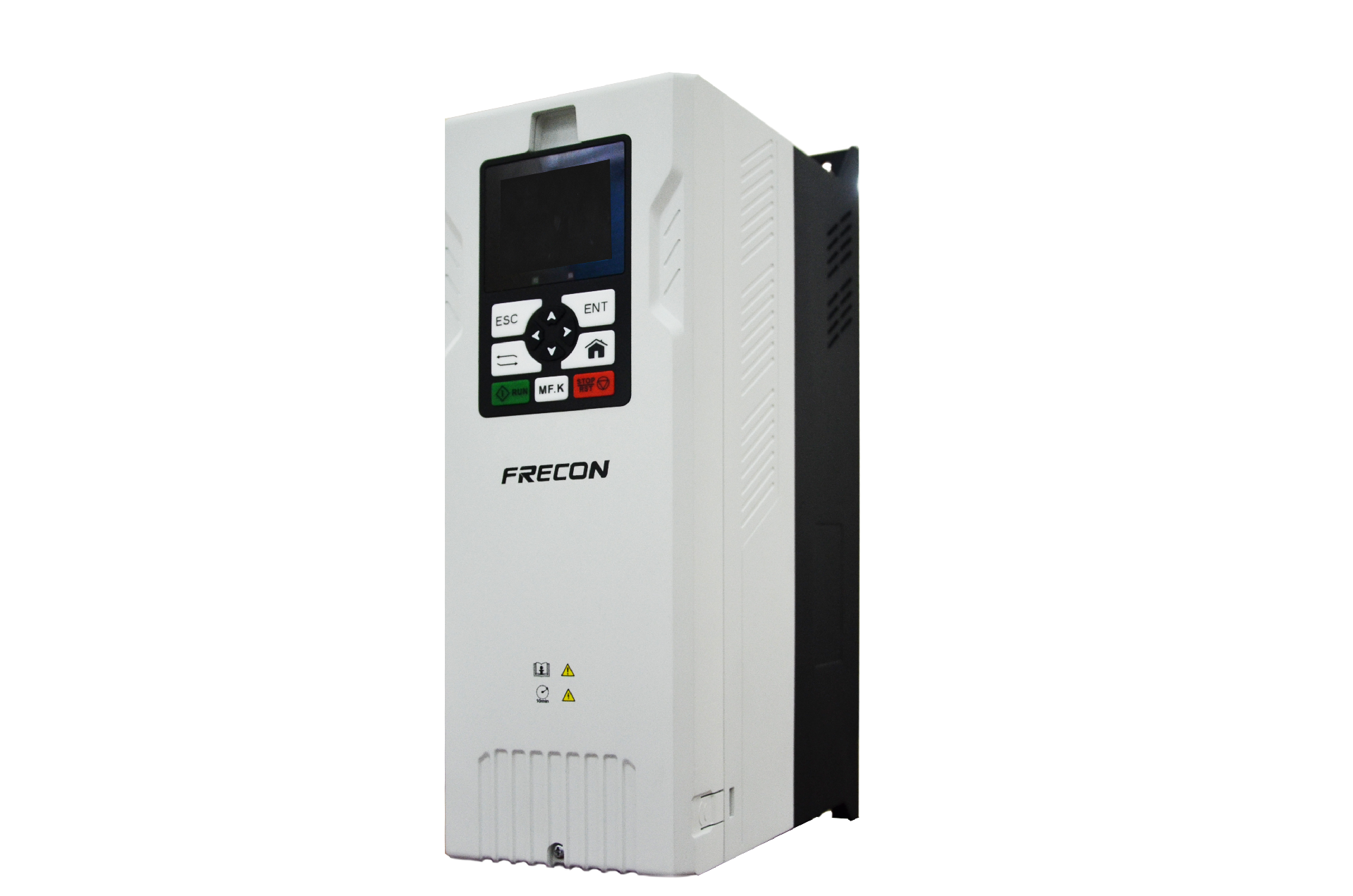
Our FR30 Series uses sensorless vector control as one of its built-in control methods. Its technical specifications list starting torque of 180% at 0.5 Hz under sensorless vector control 1 and 180% at 0.25 Hz under sensorless vector control 2. These characteristics can be relevant when equipment needs strong starting performance for demanding constant-torque applications.
Faster Torque Response Helps Manage Load Changes
Viscosity is not always constant throughout a mixing process. Formulation changes, temperature variations, ingredient additions, and different stages of material blending can alter the resistance experienced by the agitator.
A drive therefore needs to react quickly when the motor load changes. The FR30 Series specifies a torque response of less than 10 ms under sensorless vector control 1 and 2. It also provides speed accuracy of ±0.2% under these two sensorless vector control modes.
These specifications do not guarantee a particular mixing result because overall performance also depends on the motor, agitator geometry, gearbox, material properties, and control settings. However, responsive motor control gives machine designers a stronger foundation for maintaining the desired operating conditions as process resistance changes.
Sensorless Vector Offers a Practical System Architecture
One advantage of sensorless control is that it can provide advanced motor regulation without requiring a physical speed feedback device. For industrial equipment manufacturers, eliminating an encoder can simplify installation and reduce the number of components that must be integrated into the machine.
That does not mean every mixer should automatically use sensorless vector control. Encoder-based vector control may be appropriate where extremely precise speed regulation or feedback performance is required. The correct selection depends on the application's torque, speed range, process requirements, and motor characteristics.
For many industrial mixers, however, a sensorless vector drive provides a useful balance between control capability and system simplicity. This makes the technology attractive for equipment where reliable torque control is important but encoder feedback is not essential.
Why the FR30 Fits Demanding Mixer Applications
Our FR30 Series is designed as a high-performance inverter with built-in VC, SVC, and VF control modes. FRECON positions the series for applications requiring speed-control accuracy, rapid torque response, and strong low-frequency output characteristics. Its current product information covers a power range of 0.75–110 kW.
The series also supports high-precision torque control and torque control under sensorless vector operation. Its overload capability varies by model type, with the current technical documentation specifying 150% rated current for 60 seconds, 180% for 10 seconds, and 200% for 1 second for G models, while P models are rated at 120%, 145%, and 160% respectively.
For mixer builders, these functions provide flexibility when configuring equipment for different motor loads and operating conditions. The FR30 also supports built-in PID process control, multiple speed settings, programmable acceleration and deceleration curves, and motor thermal protection.
Selecting the Right Drive for Viscous Mixing
Choosing a drive for a high-viscosity mixer should begin with the actual process rather than the inverter alone. We recommend evaluating the motor's rated power, starting load, required operating speed, gearbox ratio, mixer shaft characteristics, material viscosity, and expected load variations.
Control mode should then be selected according to the required performance. A sensorless vector mode can be particularly useful when strong low-speed torque and responsive load handling are priorities. Proper motor parameter configuration is also important because sensorless control depends on accurate motor information and appropriate commissioning.
Ultimately, the drive works as part of a larger system. Mechanical design, motor sizing, gearbox selection, agitator geometry, and process control all contribute to mixing performance. A capable inverter can support the system, but it cannot replace correct engineering across these elements.
Building More Stable Mixing Systems with Smarter Drive Selection
High-viscosity industrial mixing places continuous demands on motor torque and speed regulation. When the process requires strong starting performance, responsive load handling, and stable low-speed operation, sensorless vector drive technology can offer an effective solution without necessarily requiring a physical encoder.
We at FRECON designed our FR30 Series around the need for flexible, high-performance motor control. With sensorless vector control, strong low-frequency torque characteristics, fast torque response, and multiple control functions, our product can provide a practical drive platform for demanding industrial mixer applications. By matching the inverter carefully to the motor and process, we can help equipment builders develop more stable and adaptable mixing systems.