Industrial control panels rarely have unlimited room to accommodate new equipment. As production lines expand, engineers must balance cabinet space, electrical safety, heat dissipation, and maintenance access without compromising operating stability.
Selecting a compact inverter can help reduce the space occupied by drive hardware, but successful dense installation depends on much more than physical dimensions. At FRECON, we consider how equipment layout, wiring practices, and commissioning procedures work together so that our drive solutions can fit practical industrial environments.
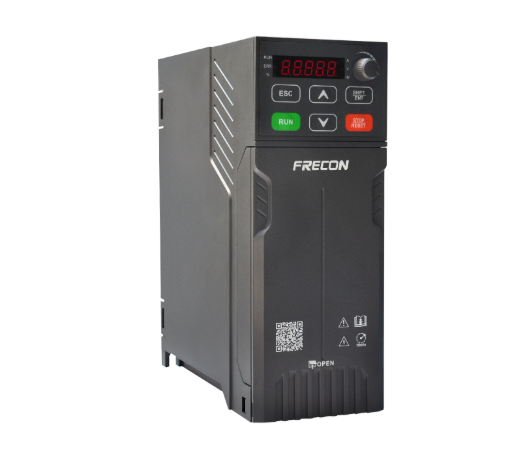
Mapping Cabinet Space Before Installation
A dense installation should begin with a cabinet layout rather than an attempt to fit components into whatever space remains. Engineers need to account for drive dimensions, cable-bending radii, terminal access, protective devices, filters, and the clearance specified by each component’s documentation. Reserving these areas early prevents avoidable rework after mounting has started.
Thermal conditions deserve equal attention. Variable frequency drives generate heat through power conversion and switching, while nearby components may add to the cabinet’s overall thermal load. If multiple units sit close together, heat from one device can raise the intake temperature of another. Layout plans should therefore reflect airflow direction, ventilation openings, ambient temperature, and the manufacturer’s stated spacing requirements rather than relying on appearance alone.
Electrical separation is another important consideration. Power cables can introduce electromagnetic interference into low-level control and communication circuits, particularly when routing runs in parallel over long distances. A multifunctional inverter installation may include speed references, digital inputs, analog signals, and communication connections, so the manual should identify suitable routing methods, shielding practices, and grounding arrangements. Clear cable paths make troubleshooting easier and reduce the chance of installation errors.
Coordinating Wiring, Protection, and Grounding
Electrical diagrams should distinguish between incoming power, motor output, control signals, and any communication interfaces. Consistent terminal labels and cable identifiers allow technicians to compare the physical installation with the drawings quickly. For installations containing several drives, naming conventions should remain consistent across the cabinet, the wiring schedule, and the commissioning records.
Protection components must be selected for the electrical system and the drive’s specified requirements. Engineers should verify supply voltage, current ratings, conductor sizing, short-circuit protection, and applicable local electrical codes. Motor cables also need suitable insulation and routing, particularly in environments exposed to heat, vibration, or mechanical wear. Installation instructions should take precedence over generic spacing or wiring assumptions.
Grounding and shielding practices require deliberate planning. Protective earthing provides a path for fault current, while appropriate cable shielding and bonding can help control electromagnetic disturbances. These measures serve different purposes and should not be treated as interchangeable. For a general-purpose inverter, the wiring guide should explain the connections and installation conditions relevant to its supported control functions, while leaving model-specific terminal assignments and electrical limits to the official documentation.
Managing Heat and Maintaining Service Access
Cabinet density directly affects the way heat moves around electrical equipment. Natural convection may be insufficient when components obstruct airflow or when ambient temperatures approach the permitted operating limit. Depending on the installation, designers may need to revise component spacing, improve ventilation, or evaluate cabinet cooling. Any changes should be checked against the drive’s specified environmental limits.
Maintenance access must remain practical after installation. Technicians may need to inspect terminals, replace fans, read status indicators, connect diagnostic equipment, or remove a drive without disturbing neighboring components. Space for these tasks should be considered alongside mounting dimensions, because a layout that fits on paper can still be difficult to service in the field.
The choice of drive format influences how these requirements are managed. A compact inverter may support a smaller panel arrangement, yet reduced external dimensions do not automatically mean lower heat generation or less required clearance. Installation teams should use the actual model manual to determine mounting orientation, ventilation space, and service access, then confirm that the finished cabinet maintains those conditions during normal operation.
Building a Repeatable Commissioning Checklist
Commissioning turns installation drawings into a verified working system. Before energizing the equipment, technicians should check mounting security, conductor termination, protective earth connections, supply compatibility, motor wiring, and the separation of power and signal circuits. The inspection should also confirm that tools, loose conductors, and other foreign objects have been removed from the cabinet.
Initial power-up should follow the documented startup sequence. Engineers can verify motor nameplate data, control mode, acceleration and deceleration times, command source, protection settings, and rotation direction. Testing at reduced speed before moving to normal operating conditions can help identify wiring or parameter issues while the system is easier to observe. Any unexpected vibration, noise, current behavior, or fault indication should be investigated before production use.
Documentation makes the process repeatable across multiple cabinets. A commissioning record can capture model and serial information, parameter settings, inspection results, test conditions, and unresolved issues. For a multifunctional inverter, recording the selected control method and active interfaces is particularly useful because similar hardware may be configured differently for separate applications. Standardized records help maintenance teams distinguish intentional configuration differences from later changes that need investigation.
Conclusion
Dense installation succeeds when space planning, thermal management, electrical protection, and serviceability are treated as connected engineering tasks. A smaller footprint can create opportunities for more efficient cabinet design, but clearances, airflow, wiring separation, and access requirements still determine whether the finished arrangement is reliable and maintainable.
At FRECON, we focus on practical drive integration and clear technical guidance to help users assess installation conditions before equipment is commissioned. Whether engineers specify a general-purpose inverter for conventional machinery or a compact inverter for a space-constrained panel, the strongest installation plan is one that follows the relevant manual, documents every critical check, and leaves technicians with a system they can inspect and service safely.