Reliable water delivery from a solar installation depends on more than the number of photovoltaic panels installed. Sunlight changes throughout the day, pump demand varies with water depth and delivery pressure, and the electrical system must respond to these conditions without relying on stored energy.
Selecting a solar pump without battery configuration therefore requires careful attention to drive specifications, source compatibility, and hydraulic requirements. At FRECON, we approach these challenges by examining how power conversion and motor control work together, helping users understand which technical parameters influence practical pumping output.
Matching Drive Specifications to Solar Conditions
Photovoltaic arrays rarely produce constant power. Irradiance, panel temperature, shading, and seasonal changes all affect the voltage and current available to the drive. Engineers should assess the array's operating voltage range, open-circuit voltage, maximum input current, and expected power production before selecting equipment. These values need to remain within the inverter's permitted limits under both normal operation and relevant environmental extremes.
The relationship between array capacity and motor demand deserves particular attention. If the available solar power falls below the level required to operate the pump, the system may reduce speed, fluctuate, or stop, depending on its control logic. Oversizing the array without checking the drive's electrical limits can also create problems. Proper matching considers the motor's rated power, starting characteristics, expected operating hours, and the site's solar resource.
Specifications published by a VFD manufacturer should be interpreted in the context of the intended installation. Input voltage ranges, allowable current, output frequency, overload capability, and environmental ratings describe different aspects of performance. Buyers should also confirm whether the stated ratings apply continuously or only for limited periods. Understanding these distinctions helps avoid selecting equipment based on a single headline figure.
Managing Power Supply Without Battery Storage
Battery-free pumping removes the need to store electrical energy for later use, reducing battery-related costs, maintenance, and replacement requirements. However, the trade-off is that water production becomes more closely tied to current solar availability. Systems designed this way are often most useful when water can be pumped during daylight into a tank, pond, or elevated reservoir for later use.
A hybrid VFD may support more than one power input, depending on its architecture. In solar pumping, compatible equipment may accept DC power from photovoltaic panels and AC power from the electrical grid. This flexibility can provide an alternative supply when sunlight is insufficient, but the actual changeover method, input requirements, and operating priorities must be verified in the product documentation. Dual-input capability should not be assumed to mean that both sources can operate simultaneously.
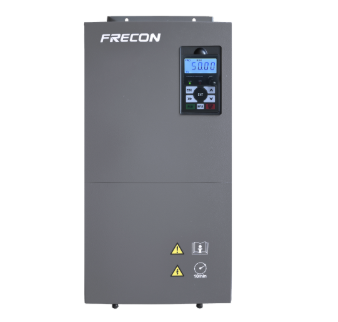
The PV600 Series Solar Pump Inverter supports DC solar power and AC grid power input, and its stated operation does not require a battery. This arrangement can suit installations where solar energy is the primary source but grid power may also be available. The series is also described as providing larger water yield under the same conditions; actual output will still depend on array capacity, pump selection, hydraulic head, and operating conditions. Installers should verify the configuration and performance requirements for their particular site.
Improving Water Yield Through Motor and Pump Matching
Water output is influenced by the relationship between motor speed and the pump's hydraulic curve. Centrifugal pumps generally deliver different flow rates and pressures as rotational speed changes, while the energy needed to overcome system resistance also varies. Consequently, inverter settings should be selected with reference to the pump manufacturer's curves rather than relying solely on the motor's rated power.
Maximum power point tracking (MPPT) helps the solar array operate near the point where it can provide the greatest available electrical power. As sunlight changes, the controller adjusts the array's operating conditions to capture available energy. Yet MPPT cannot create additional power when clouds reduce irradiance. Stable and useful water production depends on how the drive responds to reduced input, how the pump behaves at lower speeds, and whether the array has sufficient capacity for the required duty.
Engineers evaluating a solar pump without battery installation should measure both electrical performance and delivered water. Useful observations include DC input voltage, current, motor speed, flow rate, and total pumping head at different times of day. Testing across several solar conditions reveals whether the system meets daily water requirements, rather than merely demonstrating a high flow rate during peak sunlight.
Protecting Equipment Under Variable Operating Conditions
Battery-free systems experience operating changes as solar input rises and falls. If power drops below the drive's operating threshold, the pump may stop or enter a reduced-power state. The system should handle these transitions according to its documented control strategy, avoiding unnecessary repeated starts where possible. Appropriate settings depend on the motor, pump, available sunlight, and the consequences of interrupted water delivery.
Protection functions also deserve careful review. Depending on the model, relevant features may include overcurrent, undervoltage, overheating, overload, and dry-run protection. Pumping from wells or other variable water sources may require additional monitoring to prevent operation when water is unavailable. Sensor installation and parameter configuration must be checked during commissioning because protective functions cannot work reliably when signals are incorrect or disconnected.
Conclusion
Battery-free solar pumping can simplify system design, but its success depends on matching electrical capacity with real water requirements and available sunlight. A hybrid VFD may provide useful source flexibility when its supported inputs fit the installation, while careful pump sizing and MPPT operation help make better use of photovoltaic energy.
At FRECON, we believe that evaluating specifications alongside measured field performance gives users a clearer basis for choosing equipment. With realistic demand calculations, suitable protection, and well-planned commissioning, a solar pump without battery system can provide a practical option for water supply where daytime pumping and water storage meet operational needs.