Limited cabinet space, varied motor loads, and increasingly specific control requirements have changed how engineers evaluate variable-frequency drives. Selecting equipment involves more than comparing prices or rated power; the drive must fit the installation, support the required control method, and remain manageable during commissioning and maintenance.
When comparing the best VFD brands, buyers should examine technical documentation, application suitability, and long-term operating costs rather than relying on reputation alone. At FRECON, we approach drive selection by connecting practical installation needs with the control functions and operating conditions that matter most.
Defining Requirements Before Comparing Suppliers
Every drive selection should begin with the motor and its working environment. Rated voltage, current, power, frequency, and overload requirements establish the basic compatibility criteria. Engineers should also consider whether the load is a fan, pump, conveyor, or another machine, since starting torque and load variation can differ considerably. A drive selected only by matching kilowatt ratings may not provide the required current capacity or control performance.
Application details help narrow the specification further. Pumps and fans often benefit from speed adjustment as demand changes, while conveyors and transmission equipment may need more predictable torque during acceleration. Operating cycles, ambient temperature, dust exposure, and ventilation also influence the choice. Documenting these requirements before requesting quotations makes supplier responses easier to compare on equal terms.
Supplier evaluation should include technical support, parameter documentation, wiring guidance, warranty conditions, and spare-parts availability. The best VFD brands for one factory may not suit another if their control functions or service arrangements differ. Clear communication about the application can reveal whether a proposed model meets the actual requirements or includes unnecessary features that add cost without improving performance.
Understanding Control Methods and Drive Intelligence
V/F control adjusts output voltage in relation to frequency, making it suitable for many general-purpose motor applications. Sensorless vector control uses a more detailed motor model to regulate torque and speed, often improving response under changing loads. Neither method is universally preferable: the appropriate choice depends on the required accuracy, low-speed behavior, load dynamics, and commissioning resources.
A smart electric drive can provide practical benefits through accessible parameter settings, monitoring functions, and configurable control modes. However, the term “smart” does not define a consistent technical standard. Buyers should identify the actual functions available, such as fault records, communication interfaces, preset speeds, or built-in control algorithms. Checking the manual is more useful than assuming that every product marketed as intelligent offers the same capabilities.
Commissioning quality has a direct effect on drive behavior. Incorrect motor data, acceleration times, or control-mode selections can produce unstable operation even when the hardware is suitable. Engineers should follow the manufacturer's setup procedures, verify motor parameters, and test the drive across its expected operating range. Recording the final settings also makes troubleshooting easier when equipment is serviced or replaced.
Balancing Compact Design With Thermal Performance
Smaller electrical cabinets create pressure to reduce component dimensions, but compactness must be considered alongside heat dissipation and wiring access. Variable-frequency drives generate heat through power conversion and switching losses. Insufficient clearance, blocked ventilation, or high ambient temperatures can raise internal temperatures and shorten component life. Installation drawings should therefore be checked before a smaller enclosure is selected.
A compact VFD can help reduce panel footprint, particularly in machinery where space is limited. Yet the smallest unit is not necessarily the most suitable option. Engineers should check rated current, overload capacity, mounting orientation, cooling requirements, and the manufacturer's specified clearances. They should also leave enough room to connect cables safely and access terminals during inspection.
Cabinet layout affects maintenance as well as thermal performance. Adequate separation between power wiring and sensitive signal cables can reduce electrical interference, while clear labeling simplifies fault diagnosis. If multiple drives operate inside one enclosure, the combined heat load should be considered rather than evaluating each unit independently. These details often determine whether a space-saving design remains practical after installation.
Reviewing the FR01 Series for General-Purpose Applications
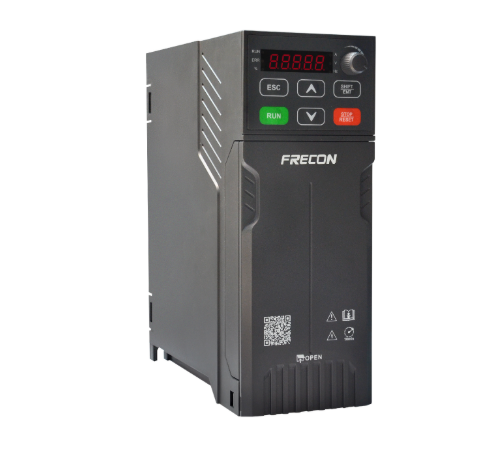
The FR01 Series Smart Inverter from FRECON combines a compact design with built-in SVC and V/F control, supporting speed regulation for different equipment requirements. Its stated features include plug-and-play setup and multiple functions, with potential applications in fans, water pumps, food processing, woodworking, and transmission equipment. Engineers should confirm the specific model's ratings and available functions against the motor and machine requirements before finalizing a selection.
Assessing Long-Term Value and Application Fit
Purchase price represents only one part of the cost of operating a drive. Energy consumption, commissioning time, maintenance access, downtime, and replacement availability can affect total ownership costs over several years. For variable-torque loads such as fans and pumps, reducing motor speed when demand falls may lower energy use, although the result depends on the system curve and actual operating schedule.
Comparisons between suppliers should use consistent criteria. Engineers can assess control performance, documented electrical ratings, enclosure requirements, service response, and the availability of application guidance. Asking for clarification on missing specifications is preferable to treating an undocumented feature as included. Where necessary, practical testing can verify performance before equipment is deployed across a larger installation.
The value of a smart electric drive ultimately depends on how well its functions match the application and how easily the maintenance team can operate it. A compact VFD should likewise be evaluated for its electrical capacity, cooling requirements, and installation constraints rather than size alone.
At FRECON, we believe that careful specification reviews and application-based testing help users make informed decisions when comparing drive solutions. A structured evaluation of the best VFD brands can then focus on measurable suitability, serviceability, and long-term operating needs instead of marketing claims.