Factory automation is evolving toward tighter machine layouts, faster commissioning, and more flexible production lines. Yet reducing the footprint of electrical equipment does not automatically improve an installation; cooling, wiring access, motor control, and maintenance still determine how well a drive performs over time.
When evaluating a slim inverter, engineers should consider how the unit fits the full control cabinet and the demands of the machinery it operates. At FRECON, we believe practical drive selection starts with the relationship between physical design, commissioning efficiency, and dependable operation.
Space Constraints in Modern Automation
Production facilities often need to fit more control equipment into limited floor space. Packaging machines, conveyor modules, and automated processing lines may have narrow electrical enclosures or distributed control panels mounted close to the machinery. Reducing drive dimensions can free space for other components, but the benefit depends on the cabinet layout and the number of devices installed.
The terms slim and compact describe related design goals, yet they do not always refer to the same dimensions or mounting arrangement. A slim design may prioritize reduced width, while another compact model may reduce depth or overall volume. Engineers should compare actual product drawings, terminal locations, cable-bending space, and required ventilation clearances instead of relying on labels alone.
Cabinet density also affects heat management. Drives produce losses during power conversion, and neighboring components may contribute additional heat. If devices are mounted too closely or airflow is restricted, internal temperatures can rise beyond recommended limits. A space-saving design is useful only when the complete enclosure can maintain suitable operating conditions.
Matching Drive Dimensions to Machine Requirements
Different automation tasks place different demands on variable-frequency drives. A conveyor may require controlled acceleration to prevent material from shifting, while a fan typically operates under a changing airflow requirement. Pumping equipment can benefit from speed adjustment as demand varies. The selected drive must therefore satisfy electrical ratings and control needs before its dimensions become the deciding factor.
Engineers should check motor voltage, rated current, power, overload requirements, and the expected operating cycle. Startup torque and frequent speed changes may influence the required drive capacity. A physically smaller unit should not be selected if its electrical ratings or thermal limits do not suit the application.
Maintenance access deserves equal consideration. Technicians need room to inspect terminals, replace wiring, read status indicators, and connect diagnostic equipment. A carefully arranged compact inverter installation can reduce cabinet space while preserving access, but an overly dense layout may make troubleshooting slower and increase the risk of wiring mistakes.
Improving Commissioning Through Smarter Configuration
Commissioning can consume substantial engineering time when many machines use similar drive settings. Repeatedly entering motor parameters, acceleration times, and control options increases the chance of inconsistent configurations. Standardized parameter sets and documented commissioning procedures help teams deploy equipment more efficiently, particularly across production lines with repeated machine modules.
A smart electric drive can support this process through a clear interface, configurable functions, and tools for transferring settings. However, the value of these capabilities depends on how easily engineers can verify each parameter and identify differences between machines. Parameter copying should be followed by checks of motor data, application-specific settings, and safety-related requirements rather than treated as a substitute for commissioning.
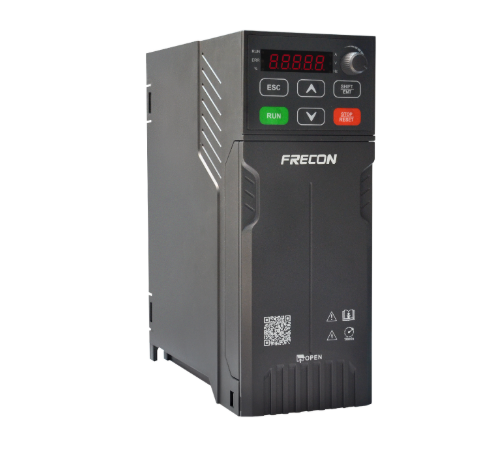
The FR01 Series Smart Inverter includes plug-and-play setup, a clear interface, and support for quick parameter copying and batch configuration. Its internal electronic jumper design simplifies wiring and logic switching without requiring manual jumper changes. These features are intended to help engineers configure equipment more efficiently and reduce wiring errors, although final settings and connections still need to be verified for each installation.
Comparing Slim and Compact Designs in Real Facilities
Choosing between a slim inverter and a more conventionally shaped compact model requires an assessment of the entire installation. Reduced width may be useful when mounting rail space is limited, whereas reduced depth can matter when cabinet doors or nearby equipment restrict clearance. Engineers should evaluate the dimensions that constrain their actual layout rather than assuming one form factor is universally preferable.
Electrical compatibility remains more important than appearance. Input and output ratings, control interfaces, communication options, protection functions, and environmental specifications should be compared against the machine requirements. If a drive must connect to a programmable logic controller or an industrial network, compatibility with the existing control architecture can influence installation effort as much as its physical size.
A practical assessment can begin with a cabinet-layout drawing and a list of operating requirements. Engineers can then compare candidate models, estimate thermal conditions, review wiring routes, and consider service access. For high-volume installations, pilot testing on one machine can reveal whether the proposed layout and configuration process are suitable before the same design is deployed across the facility.
Evaluating Long-Term Operational Value
Initial purchase price does not capture the full cost of an automation component. Commissioning labor, downtime, energy use, spare-part availability, and maintenance requirements all affect ownership costs. Standardized drive settings may reduce setup time across repeated installations, while accessible terminals and clear diagnostics can help shorten fault investigation.
Energy performance should be judged against the load profile rather than the product category. Variable-speed control can reduce consumption in suitable fan and pump applications when the process does not require full speed continuously. The results depend on system characteristics, operating hours, and control settings, so measured energy use provides a stronger basis for comparison than general claims.
Modern facilities do not necessarily prefer one enclosure shape in every situation. A compact inverter may suit installations where overall volume matters, while a narrower design may fit a particular cabinet arrangement more effectively.
At FRECON, we assess drive solutions by considering control functions, configuration needs, installation conditions, and serviceability together. The most suitable choice is the one that meets the machine's requirements while supporting efficient commissioning and practical maintenance over its working life.