Industrial drive systems increasingly need to do more than regulate motor speed. Operators expect responsive control, useful diagnostics, and dependable performance even when equipment operates in dusty workshops, humid facilities, or exposed production areas.
Integrating smart VFD technology into a protected drive can bring control intelligence closer to the motor while reducing the need for separate control components. At FRECON, we see this combination as an engineering decision that should balance environmental protection, control capability, and practical maintenance requirements.
Understand What Smart Drive Technology Adds
Traditional drives primarily adjust motor frequency and voltage to control speed. More advanced units can also process feedback signals, manage operating sequences, monitor faults, and exchange data with a plant control system. These functions help operators understand how equipment behaves as production conditions change, rather than treating the drive as an isolated power converter.
The value of intelligence depends on the application. A ventilation system may benefit from pressure-based speed adjustment, while a conveyor may need coordinated acceleration and predictable responses to changing loads. Configurable parameters, fault records, and communication options can simplify these tasks, provided the functions match the control strategy and the operators know how to use them.
Integration also affects system architecture. Functions handled locally by the drive may reduce the amount of external control hardware required, but safety-related logic and higher-level process coordination still need appropriate design. Engineers should define which decisions belong to the drive, programmable logic controller, or supervisory system before configuring the equipment.
Match Vector Control to Real Motor Demands
Control accuracy is one reason engineers consider a vector control inverter for demanding applications. Rather than relying only on a fixed voltage-to-frequency relationship, vector control estimates or measures motor variables to regulate torque and magnetic flux more independently. This can improve dynamic response and speed regulation when loads vary, although performance depends on motor data, tuning, and the selected control mode.
Sensorless vector control uses electrical measurements and a motor model instead of a physical speed encoder. It can reduce encoder wiring and simplify installation, particularly on machines where moderate speed accuracy and torque response are sufficient. Applications requiring precise low-speed operation or tight synchronization may need encoder feedback or another specialized control arrangement.
Motor selection and commissioning remain essential. Incorrect nameplate parameters can affect control estimates, while unsuitable acceleration ramps may create mechanical stress even if speed regulation is accurate. Engineers should test the drive across the expected load range, observe current and speed response, and confirm that its operating limits match the machine’s mechanical requirements.
Understand the Role of IP65 Protection
Environmental protection matters when drives are installed near dust, splashing water, or frequent washdown activity. An IP65 VFD is rated as dust-tight and protected against water jets from a nozzle under specified test conditions. This rating can be useful in certain industrial environments, but it does not mean the equipment is suitable for immersion, every chemical-cleaning process, or every outdoor installation.
The enclosure rating must be considered alongside thermal management. A more tightly sealed housing can restrict natural airflow, so heat may need to be dissipated through a designed cooling path or suitable heat-transfer arrangement. Engineers should review the manufacturer’s ambient-temperature limits, mounting orientation, spacing requirements, and derating guidance rather than assuming that a sealed enclosure will perform identically to an open-frame drive.
Installation details can affect protection in practice. Cable glands, connectors, cover seals, and mounting interfaces must preserve the intended enclosure rating. Damage during maintenance or poorly fitted accessories may create entry points for contaminants. Regular inspection of these interfaces is particularly important in facilities where cleaning, vibration, or temperature changes occur frequently.
Integrate Protection, Monitoring, and Maintenance
Combining intelligence with enclosure protection can make drive monitoring more practical in challenging locations. A smart VFD may provide fault codes, operating data, and configurable responses that help technicians identify abnormal current, overheating, or control instability. Those functions are most useful when alarms are documented and connected to a clear maintenance procedure, rather than simply displayed without follow-up.
Electrical protection must still reflect the installation. Grounding, overcurrent protection, electromagnetic compatibility, motor-cable length, and supply quality all influence system reliability. Long cable runs may require additional output filtering, depending on the drive and motor. Engineers should also distinguish ordinary drive protection from functional safety measures, which require their own risk assessment and implementation.
Select Hardware Based on Application Requirements
Specifications should be compared as a complete set rather than as isolated selling points. Rated current, overload capacity, control modes, enclosure rating, communications, cooling, and service access all affect suitability. Procurement teams should also verify that the model is certified for the intended market and that its documentation covers the actual installation conditions.
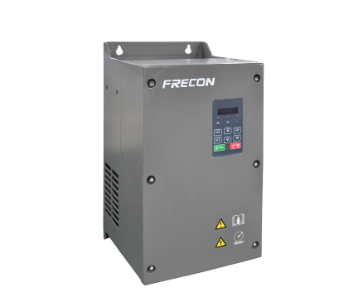
The FRECON FR380 Series Vector Control Inverter combines VC, SVC, and V/F modes with an IP65 enclosure and independent air ducts. Featuring smart PID and 150% starting torque at 0.5 Hz, it suits fan and pump applications. The series accepts three-phase 380V input in compact models starting from 178 mm wide and 5.4 kg. Buyers should verify specific model ratings for site suitability.
Conclusion
Embedding intelligent control within a protected drive can simplify industrial integration, but the benefits depend on how well the hardware matches its operating environment. A vector control inverter can provide responsive motor regulation when configured for the load, while an IP65 VFD offers a defined level of protection against dust and water jets rather than universal environmental resistance.
Combining these capabilities in a smart VFD makes sense when both control performance and enclosure requirements are verified against the application. At FRECON, we recommend evaluating the complete drive system—including cooling, wiring, commissioning, and maintenance—before deciding which functions and protection level are necessary.