Textile production places unusual demands on motor control: spinning frames require consistent speed, winding machines must manage tension, and dyeing equipment may operate through long cycles with changing loads. Embedding SVC inverter functionality into industrial drive systems can help mills respond to these demands without relying on separate speed-feedback hardware in every application.
At FRECON, we believe drive selection should begin with the behavior of the textile process, since stable production depends on how motors respond to real mechanical conditions rather than on power ratings alone.
Understand the Control Challenges in Textile Machinery
Textile machinery rarely operates under one uniform load. During spinning, small speed fluctuations can affect yarn quality; winding requires controlled tension as package diameter increases; and conveyors may experience changing material weight. These differences make it important to evaluate motor response across the full production cycle, not simply at the rated operating point.
Sensorless vector control estimates motor behavior from electrical measurements and a mathematical model. Compared with basic V/F control, it can offer improved torque regulation and speed response in suitable applications without requiring an encoder. Results depend on accurate motor data, commissioning quality, and the operating speed range, so performance at low speed should be checked against the machine’s requirements.
Control strategy also influences product consistency. Sudden acceleration can stretch yarn or disturb winding tension, while excessive speed variation may cause uneven processing. Engineers should coordinate drive ramps with mechanical inertia and process settings, then validate performance through trials using representative materials and operating speeds.
Examine Why SVC Firmware Matters
The term SVC refers to sensorless vector control, which uses a motor model to estimate operating conditions and regulate torque-producing and flux-producing components. Embedding this capability in the drive firmware allows the control algorithm to operate close to the power electronics, reducing dependence on an external speed sensor for applications where sensorless performance is sufficient.
A vector control inverter can be useful where load changes demand more responsive torque regulation than basic scalar control provides. In textile applications, this may support spinning, winding, material transport, or auxiliary machinery. Nevertheless, not every motor or process benefits equally; engineers should compare the required speed range, low-speed torque, response time, and synchronization needs before choosing a control mode.
Firmware flexibility matters when mills use different machine types across one facility. Parameter settings can be adjusted to suit each motor and production task, while documented configurations help maintenance teams restore known operating conditions after a replacement. Standardization is helpful, but copying parameters between machines without checking motor data and mechanical differences can introduce instability.
Match Drive Capacity to Continuous Production Loads
Textile equipment often runs for extended shifts, making thermal behavior and overload capability important selection criteria. A heavy duty VFD should be assessed against the motor’s rated current, starting requirements, expected overload duration, and ambient operating conditions. The drive’s nominal kilowatt rating alone may not reflect the demands created by repeated acceleration or a heavily loaded machine.
Thermal management deserves particular attention in mills where airborne fibers and lint can accumulate around cooling passages. Restricted airflow raises internal temperatures and may shorten the service life of electronic components. Engineers should review enclosure requirements, mounting clearances, cooling arrangements, and maintenance access, then establish a practical schedule for inspecting fans and removing accumulated dust.
Configure Control Around Yarn Quality and Machine Safety
Textile processes often require coordinated motion across several motors. If one section accelerates faster than another, material tension can change and affect the finished product. Drive settings should therefore be developed around the machine’s operating sequence, including start-up, steady production, deceleration, and emergency recovery. Where synchronized speed or precise tension is essential, additional feedback devices or a dedicated tension-control system may be necessary.
The SVC inverter configuration should be tuned using actual motor parameters and tested under realistic load conditions. Technicians can monitor current, speed stability, vibration, and process output while adjusting control gains and acceleration limits. Excessive tuning adjustments may create oscillation, so changes should be documented and evaluated systematically rather than made solely to suppress an individual fault.
Safety remains a separate engineering responsibility. Emergency-stop circuits, guards, interlocks, and maintenance isolation must be designed according to the machine’s risk assessment. Ordinary speed-control firmware should not be treated as a safety function. Where a safety-rated torque-disable function is required, its documentation and integration must be verified independently of the drive’s motor-control capabilities.
Use Model Features to Support Maintenance and Reliability
Maintenance teams benefit from drive systems that provide accessible fault information, repeatable parameter management, and clear installation documentation. Recording motor nameplate data, control settings, fault histories, and operating conditions can shorten troubleshooting time and help distinguish electrical problems from mechanical wear, belt slip, or changes in process load.
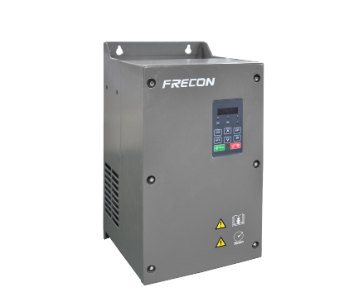
The FR380 Series supports built-in VC, SVC, and V/F control modes, along with an adaptive PID module featuring dual parameter sets. Suited for fan and pump applications, it tolerates input voltage fluctuations from -15% to +30% and weighs up to 10.8 kg depending on the power rating. Buyers should verify current ratings and control performance before adoption, as the optimal configuration depends on specific machine demands.
Conclusion
Textile mills integrate sensorless vector control because motor response affects material tension, production consistency, and equipment availability. A vector control inverter can provide useful torque regulation when its operating range matches the machine, while a heavy duty VFD must also withstand continuous production loads and the mill’s environmental conditions. At FRECON, we recommend selecting control features around measurable process needs, then validating the drive through careful commissioning and maintenance planning rather than relying on specifications alone.