Replacing a lead-acid bank with lithium—or choosing batteries for a new inverter—often starts with voltage and amp-hours. Those figures alone cannot confirm that the system will charge, start loads and shut down as intended.
A lithium ion battery for inverter use needs a supported voltage range, sufficient current capability and an approved operating mode. Matching a lithium battery with inverter equipment on those points provides the basis for selecting the bank and configuring the system.
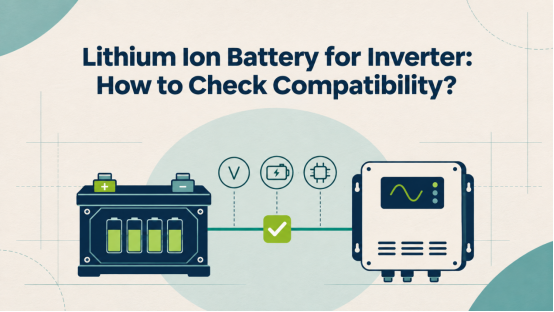
How Do You Check a Lithium Ion Battery for Inverter Compatibility?
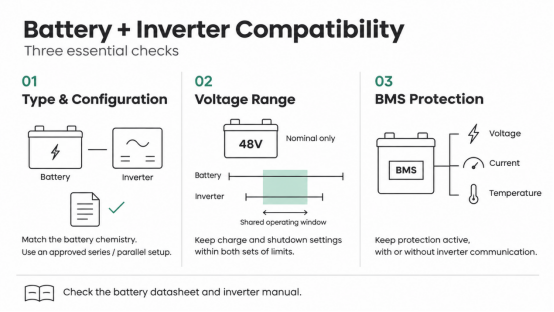
Electrical compatibility starts with the battery type, its working voltage range and active BMS protection. Begin with the exact battery datasheet and inverter manual.
Match the specified chemistry to the inverter’s supported battery types. For multiple modules, verify the approved series/parallel arrangement as well: the resulting bank must be supported by both manufacturers.
Why the Full Voltage Range Matters
A 48V inverter label describes a nominal class, while battery voltage changes during charging and discharge. An off grid lithium battery can therefore carry a familiar label yet require charging or shutdown settings outside the inverter’s limits.
Compare the battery’s required charging voltage and permitted discharge range with the inverter’s DC input range. The planned charging and shutdown settings must stay within both sets of limits. If only nominal voltage is published, obtain the missing ranges before confirming the pairing.
Keep BMS Protection in Place
A lithium ion battery for inverter use also needs protection against cell overvoltage, undervoltage, overcurrent and unsuitable temperatures. Verify these functions in the battery specifications, including charging and discharging temperature limits. BMS protection must remain effective in the approved configuration even when no direct inverter communication is used.
How Do You Match Battery Current Limits to Inverter Demand?
Voltage compatibility establishes electrical fit; current capability determines whether the bank can supply the loads. A lithium ion battery for inverter use may store enough energy yet deliver too little current for the intended equipment.
Turn the Running Load into Battery Current
Total the watts of the AC loads that may run together. Divide that load by the planned battery operating voltage and inverter efficiency, expressed as a decimal.
Illustrative calculation: Assume a 5,000 W AC load, an actual battery voltage of 48 V and 90% inverter efficiency:
5,000 ÷ (48 × 0.90) ≈ 116 A
A lithium ion battery for inverter use and its BMS must both have continuous-current ratings covering this demand. A bank limited to 100 A would not cover this example, regardless of its amp-hour capacity.
For a real 48V inverter installation, calculate at the lowest planned operating voltage, use applicable efficiency data and follow the manufacturer’s published DC-input sizing requirements.
Starting loads need a separate check
A motor’s startup current may last longer than the battery’s peak allowance. Have the installer establish the corresponding battery-side current and duration, then compare both with the off grid lithium battery specifications. If either exceeds the permitted allowance, select an approved higher-current configuration.
Charging reverses the direction of power flow
The charge setting for a lithium ion battery for inverter use comes from the battery’s recommended current and battery/BMS limits. For a lithium battery for solar system use, divide that allowance among simultaneously operating PV, AC and external chargers, keeping their combined current within the chosen limit.
Will the Battery’s BMS Communicate with Your Inverter?
BMS communication lets a supported pairing exchange battery data and operating limits. When specifying a lithium battery with inverter communication support, use an integration guide covering both model numbers to complete the following checks.
Check | What to record | Required result |
Interface and ports | CAN or RS485 interface and the designated port on each device | Use the port pairing named in the integration guide. |
Protocol and firmware | Battery model, protocol selection, firmware versions and address settings | The pairing is covered by applicable instructions or manufacturer confirmation. |
Communication cable | Approved cable part number, or verified pin-to-pin mapping including required grounding/shielding | Order the specified cable; have a qualified installer verify any custom wiring. |
Communication loss | Alarm, any timeout, charging/discharging restrictions and recovery procedure | The documented behavior meets the project’s backup requirements. |
For a lithium ion battery for inverter backup, have the installer verify valid operating data and the documented loss-of-communication response during commissioning.
Which Battery Modes and Operating Settings Need to Match?
The next decision is how the inverter will control charging and interpret battery status. Configure the lithium ion battery for inverter operation through a mode explicitly supported by the selected equipment.
Choose the Supported Control Mode
l With BMS communication, the inverter can use battery-reported state of charge (SOC) and operating limits where the protocol supports them. When operating a lithium battery with inverter communication enabled, select the prescribed battery mode and protocol, then verify that the expected data is received.
l Without direct communication, an approved user-defined or voltage-based mode relies on configured settings. The off grid lithium battery still needs effective BMS protection, while displayed SOC may be estimated from voltage rather than reported by the battery.
Coordinate the Settings Used by That Mode
For a lithium battery for solar system use, match charging voltage, current and any float behavior to the battery instructions. Lead-acid presets should be reviewed during conversion, and equalization should remain disabled unless the lithium battery manufacturer explicitly permits it.
Then compare charging cut-offs, low-voltage shutdown, battery-to-utility transfer and return thresholds. Apply the model’s required ordering and spacing so normal operation stays within battery limits and avoids repeated source switching or BMS protection trips.
How Can FRECON SP200 Support Lithium Battery Integration?
Once the battery requirements are defined, inverter selection becomes a comparison against known limits. The FRECON SP200 Solar Hybrid Inverter offers two 48V inverter options for matching load power and battery charging requirements.
The SP200-6500-48 provides 6.5 kW output and up to 120 A total solar-plus-AC charging; the SP200-12000-48 provides 12 kW and up to 160 A. For a lithium battery for solar system storage, select output capacity for the loads and set actual charging current to the battery’s approved value within the inverter’s maximum.
l Battery Connection and Startup
CAN/RS485 BMS interfaces provide a communication path for compatible batteries. The lithium battery activation function offers a startup option where the selected equipment supports the prescribed activation procedure.
l Monitoring and Output Expansion
Wi-Fi mobile app monitoring lets site teams review operating information remotely. For expansion, the current specification table lists up to nine SP200-6500-48 units or six SP200-12000-48 units in parallel. Increasing output also requires reassessing battery-bank and BMS current capability.
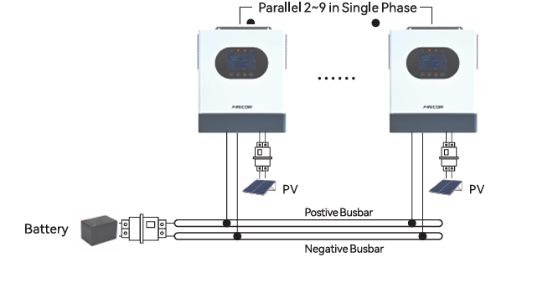
Choosing a lithium ion battery for inverter use is a system-matching task. SP200’s model options, BMS interfaces and monitoring features can support that design once the battery, protocol and settings have been verified.
Take a closer look at FRECON SP200 for your next lithium battery project. If you have other inverter needs, feel free to contact us.